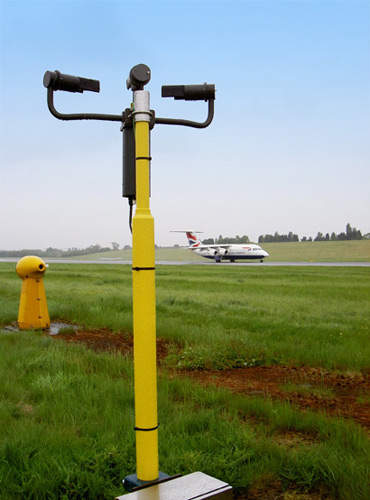
Aeronautical & General Instruments (AGI), an established UK company, manufactures instruments and systems for busy airport runways, including portable / emergency airfield lighting systems, runway visual range systems, airport surface wind measurement systems and AWOS (Automatic Weather Observing Systems).
Portable emergency airfield lighting systems
In 2007 AGI acquired Metalline International and consequently its division Metalite Aviation Lighting. Metalite Aviation Lighting is able to offer a full-range of portable emergency airfield lighting systems, covering runway and taxiway-edge lights, approach lights, PAPIs and obstruction lights.
Products are battery and generator-powered and can provide visual and NVG-compatible light outputs, making them suitable for use by civilian and military users. Lighting can be supplied as individual units supported by freestanding battery chargers or in road going trailers with integral charging facility.
Portable LED civilian omni-directional runway edge lights
The Metalite COREL LED is an energy-efficient battery powered portable runway light, which meets FAA, ICAO and CAA specifications in the full range of aviation lighting colours / applications. These super-efficient portable aviation lights offer unparalleled run times, meaning reduced maintenance and fewer charge cycles, resulting in a greater return on investment.
Simple drop in charging keeps recharging cycles down to a minimum amount of effort for ground staff. Built to last and to withstand the harshest environments, Metalite products are renowned for their high build quality and use in extremes, such as deserts, tropical conditions and sub zero locations, including the Antarctic.
Radio control
The full range of LED products is available with MESH network technology, allowing the runway lights to be operated from the air traffic control tower, up to a range of 4km, each light then re-transmits the signal to the next light, ensuring the signal is not lost by obstructions and allowing an infinite length of runway.
Visual-spectrum precision approach-path indicator (VIS PAPI) – LED
A battery-powered portable visual-spectrum precision approach-path indicator, the VIS PAPI, uses an incandescent light source and is suitable for night-time use in compliance with CAA document CAP 168.
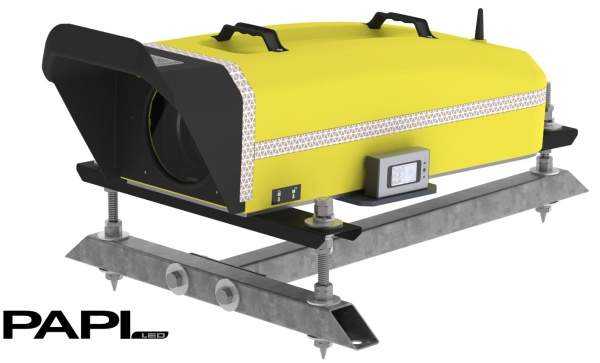
Recently launched by Metalite is the world’s most power-efficient PAPI LED, meeting FAA and ICAO specifications for both night and daytime operation, with runtimes in excess of 1,100 hours on a single battery charge.
Runway End Identifier Light (REIL LED)
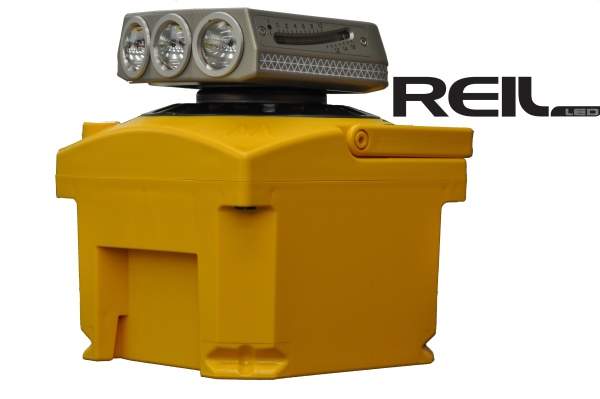
A pair of battery-powered portable approach lights suitable for night-time or daytime use, the REIL LED’s provides a synchronised strobe light up to 15,000 candela to identify the runway end or threshold of a visual or instrument non-precision runway. Highly efficient, the REIL LED can operate up to 1,100 hours on a single 8 hour battery charge, meaning that they can remain in place for long periods of time before recharging is required.
Unidirectional Approach Light (UAL)
A battery-powered portable approach light suitable for night-time use, the UAL enables pilots to identify the runway centreline during approach.
Battery charger for airfield lighting
Our freestanding, portable drop-in charger for the range of halogen or LED runway lights is capable of charging up to 16 halogen or LED CORELs, REIL LED’s and UALs simultaneously in approximately eight hours. Highly portable and protected within a durable PELICASE design, this is an ideal solution for helipads, obstruction areas and smaller lighting requirements.
CALKIT LED
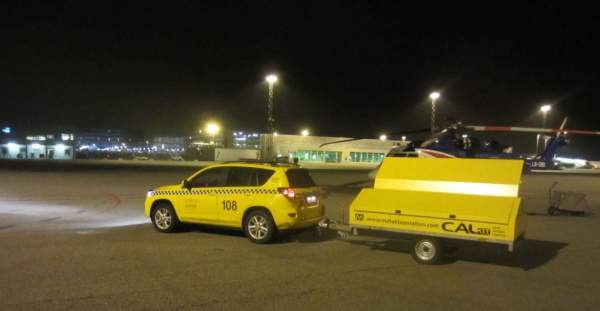
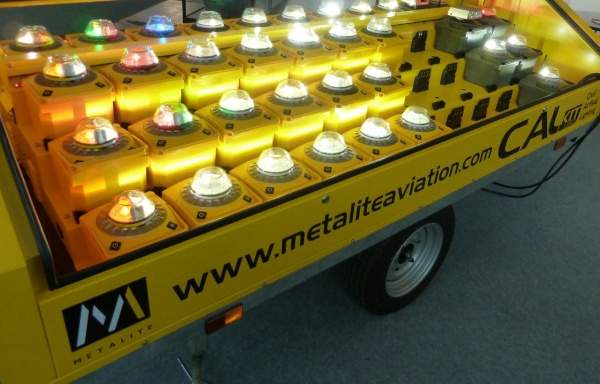
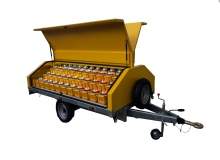
A versatile trailer-mounted, battery-powered portable runway lighting system that complies with international civil aviation standards, the Civil Airfield Lighting KIT (CALKIT LED) can be used as a stand-alone, temporary system on remote airstrips or as emergency, supplementary or obstruction lighting at international and domestic airports. Holding up to 66 light units, the CALKIT LED can deliver lighting for runways of up to 2,800 meters in length, with runway edge lights spaced at 100m. It can be easily deployed within 20 minutes with two operators.
CALKIT has been deployed in every Continent throughout the world since the since 1992 and continues to be the market leader in this sector.