
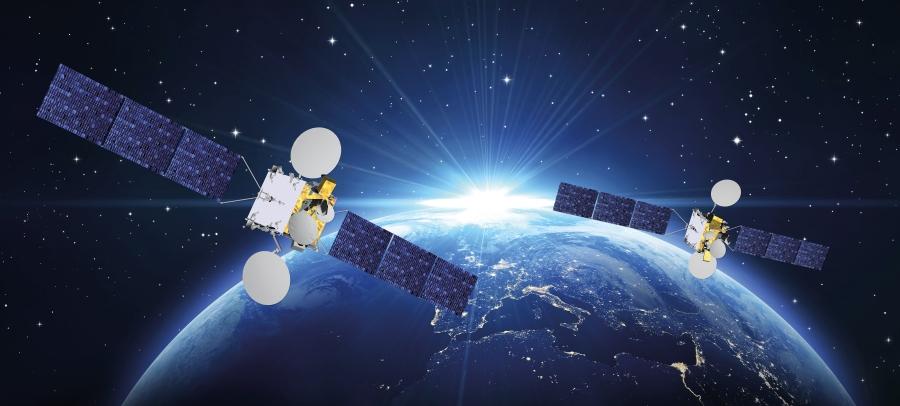
Thales Alenia Space has completed the preliminary design review (PDR) of the Koreasat-7 and Koreasat-5A satellites.
Planned to be operated by KT’s subsidiary KTSAT, the satellites will serve South Korea, the Philippines, Indonesia, India, Japan, Indochina and the Middle East regions with internet access, multimedia, broadcasting and fixed communications services.

Discover B2B Marketing That Performs
Combine business intelligence and editorial excellence to reach engaged professionals across 36 leading media platforms.
The satellites will be built based on Spacebus 4000B2 platform, and will have payload power of around 7kW.
Koreasat-5A will be equipped with Ku-band transponders, while Koreasat-7 will carry Ku-band transponders and Ka-band transponders.
Koreasat-7 and Koreasat-5A will weigh around 3,500kg at launch, and operate from 116°E and 113°E orbital locations, respectively.
Thales Alenia Space business line telecommunication executive vice-president Bertrand Maureau said: "The completion of the PDRs shows that the design of the Spacebus 4000B2 spacecraft perfectly meets KTSAT’s requirements and that the satellites are on track for service entry by the end of 2016.
"Our aim is to ensure KTSAT’s full satisfaction with this large-scale space programme, which is very important for both South Korea and Asia."
Thales Alenia Space secured a contract from KT in May last year, to build the two telecommunications satellites.
The company will be responsible for design, production, testing and on ground delivery of the satellites as well as launch campaigns, launch and early operations phase (LEOP) and in-orbit tests (IOT).
Image: Koreasat-7 and Koreasat-5A are on track for service entry by the end of 2016. Photo: courtesy of Thales Alenia Space.


