
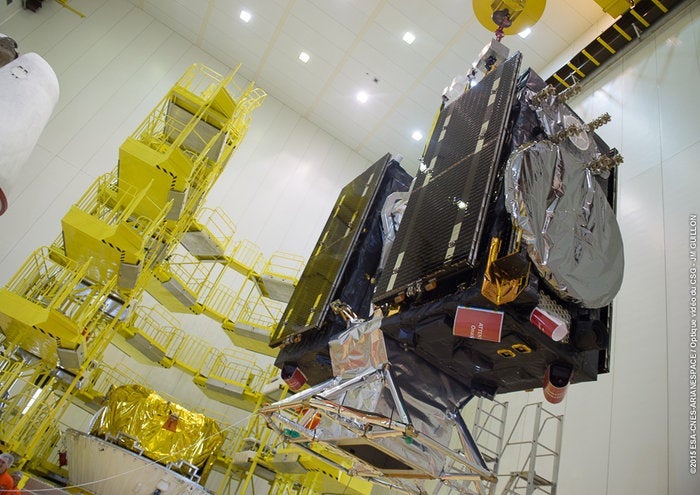
The ninth and tenth Galileo satellites have been installed on top of the Fregat upper-stage for launch aboard the Soyuz rocket on 11 September, from spaceport in French Guiana.
The pair was lowered onto the waiting upper-stage in the 3SB preparation building of the space centre.

Discover B2B Marketing That Performs
Combine business intelligence and editorial excellence to reach engaged professionals across 36 leading media platforms.
Functional checks and inspections have been completed to encapsulate Galileos and Fregat within the halves of the Soyuz rocket fairing.
The upper composite will be moved to the launch site to attach it vertically to the first three stages of the Soyuz ST-B.
Once these achieve low orbit, the Fregat will carry the satellites to the designated medium-altitude orbit.
Named Flight Models 5 and 6 of the Full Operational Capability version, the navigation satellites will be placed at 23,222km orbital altitude and 57.394° inclination.

US Tariffs are shifting - will you react or anticipate?
Don’t let policy changes catch you off guard. Stay proactive with real-time data and expert analysis.
By GlobalDataThis will be the fifth Galileo launch, bringing the number of Galileo satellites in space up to ten.
Two more satellites are planned for launch by the end of this year.
The ESA’s ESTEC technical centre in Noordwijk, the Netherlands, is performing tests on one of the satellites, while the other is being prepared for transportation to Kourou in October.
The first satellite of the following batch (Galileo 13) is undergoing a thermal-vacuum test at ESTEC. The next one will reach the centre later this month.
Galileo is Europe’s global satellite navigation constellation comprising 24 operational satellites and six spares, to provide an encrypted commercial service by 2020.
The programme is co-funded by the ESA and the European Commission.
Image: Galileos approach Fregat. Photo: courtesy of ESA/CNES/ARIANESPACE-Service Optique CSG.


