
Nasa has selected Amprius and University of Maryland, College Park’s proposals for the second development phase of advanced energy storage technologies, which will be used to power the agency’s future space missions.
California-based Amprius will work on silicon anode-based cells for high-specific energy Li + systems project, while the University of Maryland will develop garnet electrolyte-based safe, lithium-sulphur energy storage system.

Discover B2B Marketing That Performs
Combine business intelligence and editorial excellence to reach engaged professionals across 36 leading media platforms.
The latest proposals have been selected by Nasa’s Game Changing Development (GCD) programme, with the aim of developing technologies to replace its existing battery systems.
The high-energy storage devices are said to help reduce the mass of storing electrical power in space, thereby supporting the future robotic and human exploration missions.
Nasa space technology mission directorate associate administrator Steve Jurczyk said: "Technology drives exploration, and battery technology is a critical element of that drive.
"These next-generation batteries will dramatically improve the availability and affordability of the power and energy required for future exploration missions.
"The development effort will focus on delivering safe, low-mass batteries to enable longer missions deeper into space."
The National Research Council’s ‘Nasa Space Technology Roadmaps and Priorities’ calls for reliable power systems, and need to eliminate the constraint of power availability for space missions.
Last year, Nasa awarded four proposals approximately $250,000 of funding to perform eight months of component test and analysis work.
Under phase two, the awardees will receive $1m for an engineering development unit hardware phase, for one year.
In the third phase, the agency will grant as much as $2m per award to support 18 months of hardware development work on the prototypes.
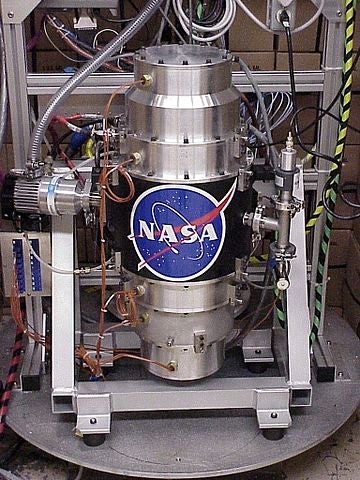
Image: Nasa G2 flywheel module to store rotational energy for use by spacecraft. Photo: courtesy of Nasa.


