
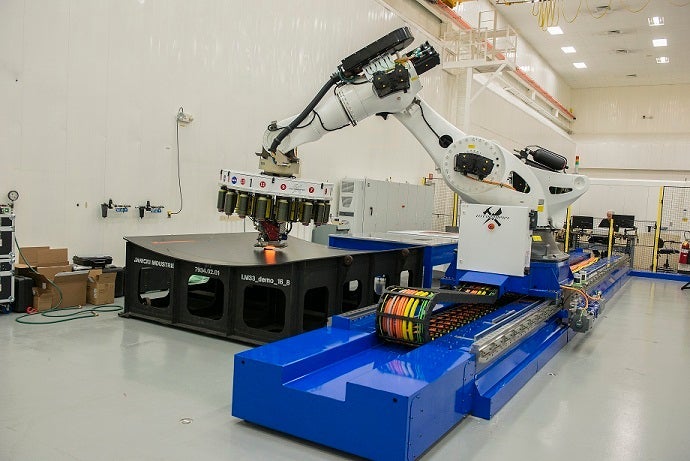
Nasa has installed a composites manufacturing robot at its Marshall Space Flight Center in Huntsville, Alabama, US to produce large composite rocket structures.

Discover B2B Marketing That Performs
Combine business intelligence and editorial excellence to reach engaged professionals across 36 leading media platforms.
Said to be one of the largest in America, the machine will help the agency to build 26ft-long lightweight composite structures ever made for space vehicles, such as heavy-lift Space Launch System (SLS).
Nasa mounted the robot on a 40ft-long track at Marshall’s Composites Technology Center which is part of its National Center for Advanced Manufacturing.
The robot features a 21ft arm that articulates in multiple directions, and a head which can hold up to 16 spools of carbon fibres. These fibres will be placed onto a tooling surface in precise patterns to make a large composite panel of varying shapes and sizes.
Marshall Space Flight Center engineering directorate deputy director Preston Jones said: "This addition to Marshall’s Composites Technology Center provides modern technology to develop low-cost and high-speed manufacturing processes for making large composite rocket structures.
"We will build and test these structures to determine if they are a good fit for space vehicles that will carry humans on exploration missions to Mars and other places."
Nasa is evaluating composites manufacturing technologies for SLS and other exploration spacecraft such as landers, rovers, and habitats.
Marshall and Electroimpact engineers worked together to customise the robot and supporting software for large structures.
As part of a technology demonstration mission (TDM) programme, Marshall engineers will design, build, test, and address flight certification of large composite structures.
These large structures will be evaluated under simulated space conditions on Marshall structural test stands.
Marshall composites expert Larry Pelham said: "Robotic systems allow Nasa to support a variety of research and development from low technology readiness levels to high technology readiness levels where structures are ready for flight tests."
Image: The 21ft robot arm moves on a track. Photo: courtesy of Nasa / MSFC / Fred Deaton.


