
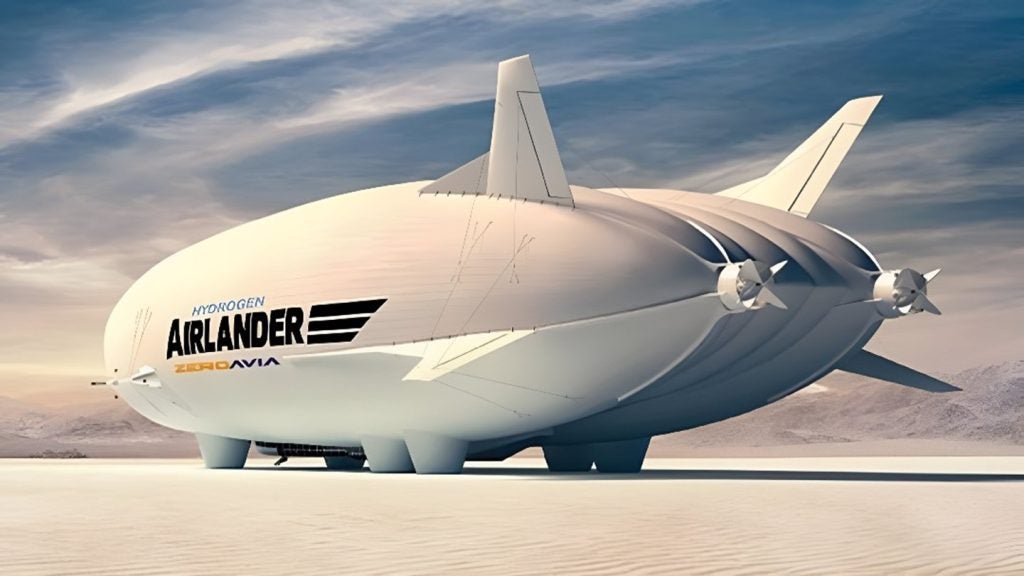
ZeroAvia has entered into a memorandum of understanding (MoU) with Hybrid Air Vehicles to advance the development of a hydrogen-electric version of the Airlander 10 aircraft.
The MoU is intended to facilitate the integration of ZeroAvia’s hydrogen-electric propulsion system into the Airlander 10 platform, which is currently designed to operate using four diesel engines.
Through the collaboration, the companies intend to achieve zero-emission in-flight operations for aircraft capable of carrying more than 100 passengers, with expectations for a reduction in maintenance expenses.
This partnership builds on earlier research by Hybrid Air Vehicles focused on electric propulsion for the Airlander model.
ZeroAvia founder and CEO Val Miftakhov said: “Airlander is another exciting airframe for line-fit of our powertrains as it can open up a whole new market in air travel due to its range, efficiency and ability to operate from almost anywhere.
“Like ZeroAvia, Hybrid Air Vehicles is an aerospace innovator with exciting manufacturing and growth plans for the UK that can deliver hundreds of well-paid jobs in different regions in the UK.”
Airlander 10 blimp is characterised by its hybrid lift system, combining aerostatic and aerodynamic lift with vectored thrust. The aircraft has a payload capacity of 10t and can travel up to 4,000nm.
According to the companies, the initial diesel-powered variant is expected to reduce emissions by up to 90% in comparison to aircraft of similar capacity.
ZeroAvia’s ZA600 hydrogen-electric powertrain, rated at 600kW, has completed several regulatory benchmarks and secured pre-orders from airlines preparing to introduce the technology on traditional fixed-wing models.
The company reported that it has flight tested a prototype in a 19-seat aircraft as part of its development process.
As part of the MoU, the companies will also assess whether ZeroAvia’s hydrogen-electric technology can be applied to larger aircraft that Hybrid Air Vehicles may develop in the future.
In addition, both firms will evaluate operational plans for Airlander 10 in order to identify requirements for hydrogen fuel infrastructure.
The hull of Airlander is said allow significant space for hydrogen storage, which could facilitate adoption of existing certified hydrogen technologies including storage solutions, proton exchange membrane (PEM) fuel cells, and electric propulsion systems.
Hybrid Air Vehicles CEO Tom Grundy said: “ZeroAvia has led the development of hydrogen-electric propulsion systems and made impressive progress commercially, technically and with regulators.
“Our intention has always been to offer our customers a fully zero-emission variant of the Airlander, for efficiency and environmental reasons, and this partnership with ZeroAvia will help us in this direction.”
Recently, ZeroAvia was chosen to enter grant agreement preparations after the European Union (EU) Innovation Fund decided to support its €21.4m ($24.5m) application.