
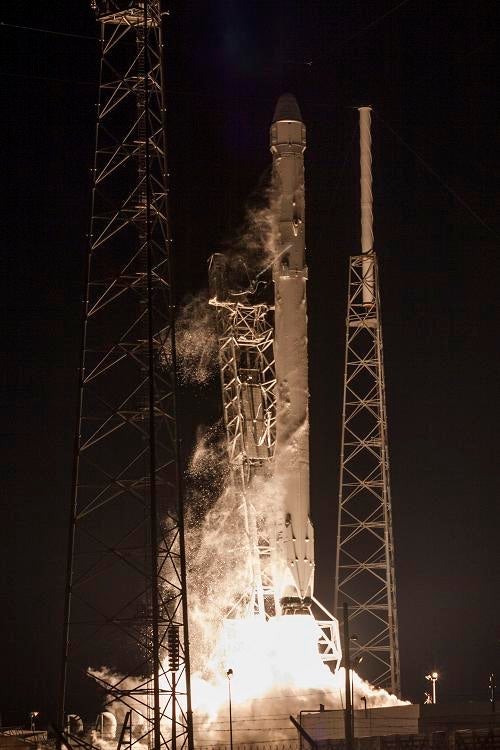
Space Exploration Technologies (SpaceX) has failed in its attempt for precision landing of Falcon 9 first stage on an autonomous spaceport drone ship, as part of the fifth cargo resupply flight to the International Space Station (ISS).
The company has been working to design a rocket that can be recovered and re-used for future flights thereby reducing launch costs.

Discover B2B Marketing That Performs
Combine business intelligence and editorial excellence to reach engaged professionals across 36 leading media platforms.
Powered by nine Merlin first stage engines, the Falcon 9 lifted-off from Cape Canaveral Air Force Station in Florida, US.
Three minutes after liftoff, the Falcon 9’s first and second stages separated and the second stage’s Merlin Vacuum engine ignited to bring Falcon 9 and Dragon into low-Earth orbit.
SpaceX said in a statement: "While the rocket made it to the drone ship, it landed hard.
"Unfortunately, we weren’t able to get good landing video because of the dark and fog, but we are in the process of evaluating invaluable telemetry data, which will inform future attempts."
SpaceX founder and CEO Elon Musk was quoted by Reuters as saying that the Falcon 9 ran out of hydraulic fluid to operate its steerable fins, but the next flight having 50% more of this fluid.
The Dragon separated from the second stage after ten minutes into flight, and will conduct a series of burns to reach the ISS.
The Dragon capsule is carrying supplies and equipment, which will support over 250 experiments to be carried out by the Expeditions 42 and 43 crews.
SpaceX’s latest flight is part of the $1.6bn contract with Nasa for 12 resupply missions to ISS.
Image: The Falcon 9 lifted-off from Cape Canaveral Air Force Station in Florida, US for the fifth cargo resupply flight to ISS. Photo: courtesy of Space Exploration Technologies.


