
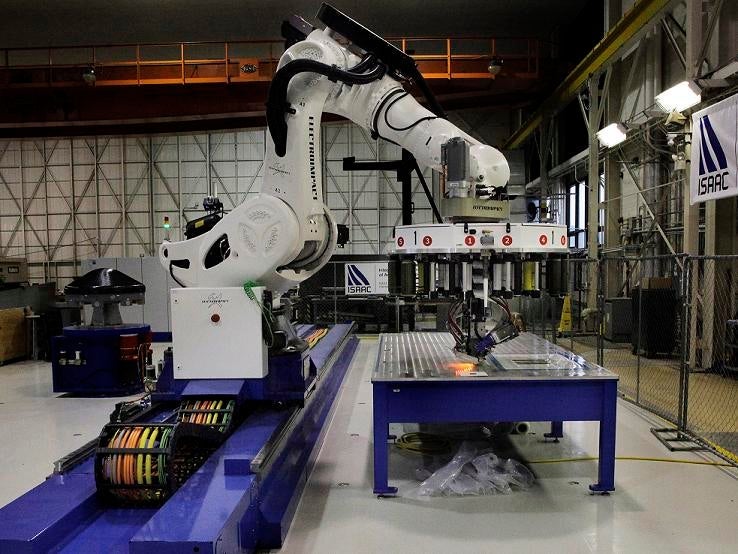
Nasa is preparing to use an integrated structural assembly of advanced composites (Isaac) robot to produce composite structures and materials for aerospace vehicles.
Placed at the agency’s Langley Research Center in Hampton, Virginia, US, Isaac is said to be one of the three such systems in the world and will be put into operation this month.

Discover B2B Marketing That Performs
Combine business intelligence and editorial excellence to reach engaged professionals across 36 leading media platforms.
Isaac project integration manager Brian Stewart said: "It changes how we look at composites.
"We can convert research ideas into real projects pretty quickly."
Nasa researchers plan to use the system for advanced composites project and composites for exploration upper stage.
The team could also use Isaac to build scaled-down models of aircraft and spacecraft for research purposes, and aero-elastic structures for wind tunnel tests.
Researchers are working on identifying ways to use the robot to build metal parts or structures.
Isaac has been developed over Kuka standard industrial robot concept, and is built by Electroimpact.
The system features a rotating, disc-like head, which can be replaced with identical ones loaded with different tools.
The head is loaded with around 16 spools of carbon-fibre ribbon, a key raw material used in composite materials.
The system can fuse the carbon-fibre ribbons into sheets of material as per the requirement. The sheets are layered one above the other to create a solid, durable mass, Nasa said.
Stewart added: "We can use these interchangeable heads for all sorts of amazing things, almost anything we can dream up."
Image: ISAAC can fuse ribbons of carbon-fibre and epoxy into sheets of material to create a solid, durable mass. Photo: courtesy of Nasa / David C Bowman.


