
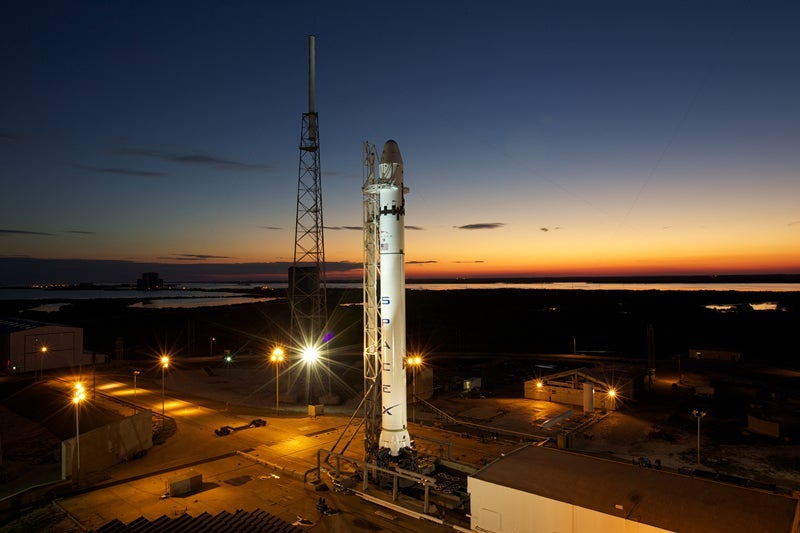
SpaceX has aborted the launch of its Dragon capsule to the International Space Station (ISS) aboard a Falcon 9 rocket, following problems related to high pressure within an engine combustion chamber.

Discover B2B Marketing That Performs
Combine business intelligence and editorial excellence to reach engaged professionals across 36 leading media platforms.
Successful lift-off requires all nine engines, but SpaceX president Gwynne Shotwell said the aborted launch is not a failure.
"It would be a failure if we were to have lifted off with an engine trending in this direction," Shotwell added.
The agency reported that it has found the root cause for the problem and, with repairs currently underway, SpaceX expects to attempt a launch on 22 May 2012.
SpaceX has previously faced temporary delays to the Falcon 9’s first-ever flight due to an issue with the rocket’s engine five, but was launched due to the existence of longer launch window and the company was able to recover the defect.

US Tariffs are shifting - will you react or anticipate?
Don’t let policy changes catch you off guard. Stay proactive with real-time data and expert analysis.
By GlobalDataThe launch of Falcon 9, equipped with the unmanned Dragon and about a half a ton of cargo, will mark the first attempt to launch a private spacecraft to ISS, where the space company is planning to conduct a fly-under followed by a berthing.
SpaceX, being the first of several US competitors to attempt a launch of its own cargo-bearing spacecraft to the ISS, is aimed at reinstating US access to space for human travellers by 2015.
Previously, the space agencies of Russia, Japan and Europe were capable of sending supply ships to the ISS, while the US also had that capacity with its space shuttle which served as part of an astronaut bus and part delivery truck for the ISS.
The end of the 30-year shuttle programme in 2011 made Russia the only taxi for astronauts to the ISS until such a replacement could be provided by the private industry.
Nasa has awarded billion-dollar contracts to SpaceX and Orbital Sciences to transport cargo to the ISS in the upcoming years, and the companies will also receive funds for meeting key milestones in their projects.
Image: The full flight-ready Falcon 9 with Dragon spacecraft on the launch pad at SLC-40, Cape Canaveral, Florida. Photo courtesy of: SpaceX / Roger Gilbertson.


