
 Australian satellite company NewSat has received $280m from the Export-Import-Bank of the US (Ex-Im Bank) for the launch of the first of two planned satellites, Jabiru-1, before the end of 2014.
The funding for the first Australian commercially-owned orbiting device programme will be followed by an expected $100m debt facility guarantee from French export credit agency Coface in July.

Discover B2B Marketing That Performs
Combine business intelligence and editorial excellence to reach engaged professionals across 36 leading media platforms.
NewSat has also revealed the requirement of an estimated $600m to fund the programme and further plans to raise an additional $200m in funding for the project.
The satellite firm is also planning to launch future planned satellites, Jabiru-2, Jabiru-3 and Jabiru-4. NewSat said that Jabiru-2 would not be a satellite but would be the company’s dedicated payload on the Measat-3b satellite.
Equipped with around 100 Ka-band transponders each, Jabiru-3 and 4 will be launched in 2016 and 2017 and sent into orbits at 89.5°
east and 54.0° east respectively.
With a design life of 15 years, the Jabiru-1 satellite will provide more than 7GHz of Ka-band capacity and high-powered coverage of regions over the Middle East, Africa and Asia.

US Tariffs are shifting - will you react or anticipate?
Don’t let policy changes catch you off guard. Stay proactive with real-time data and expert analysis.
By GlobalDataThe services will be targeted to serve the government and enterprise markets, such as mining, oil, gas, media and carrier-grade telecommunications that are located across Middle Eastern and West Asian regions.
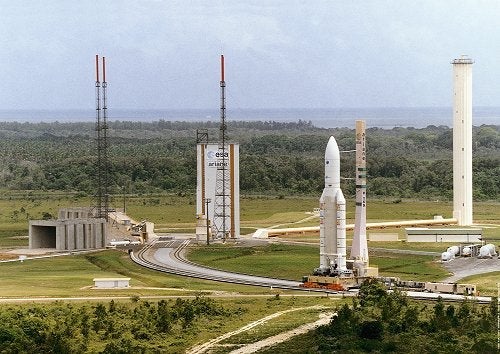
Constructed by Lockheed Martin Commercial Space Systems, Jabiru-1 is based on the A2100 platform and will be launched by Arianespace from the Guiana Space Centre, French Guiana.
According to NewSat, Jabiru-1 will generate revenue of nearly $2bn over its 15 year operation and a 50% profit margin.
Image: Jabiru-1 satellite will be launched from the Guiana Space Centre, French Guiana in the fourth quarter of 2014. Photo: courtesy of Arianespace.


