
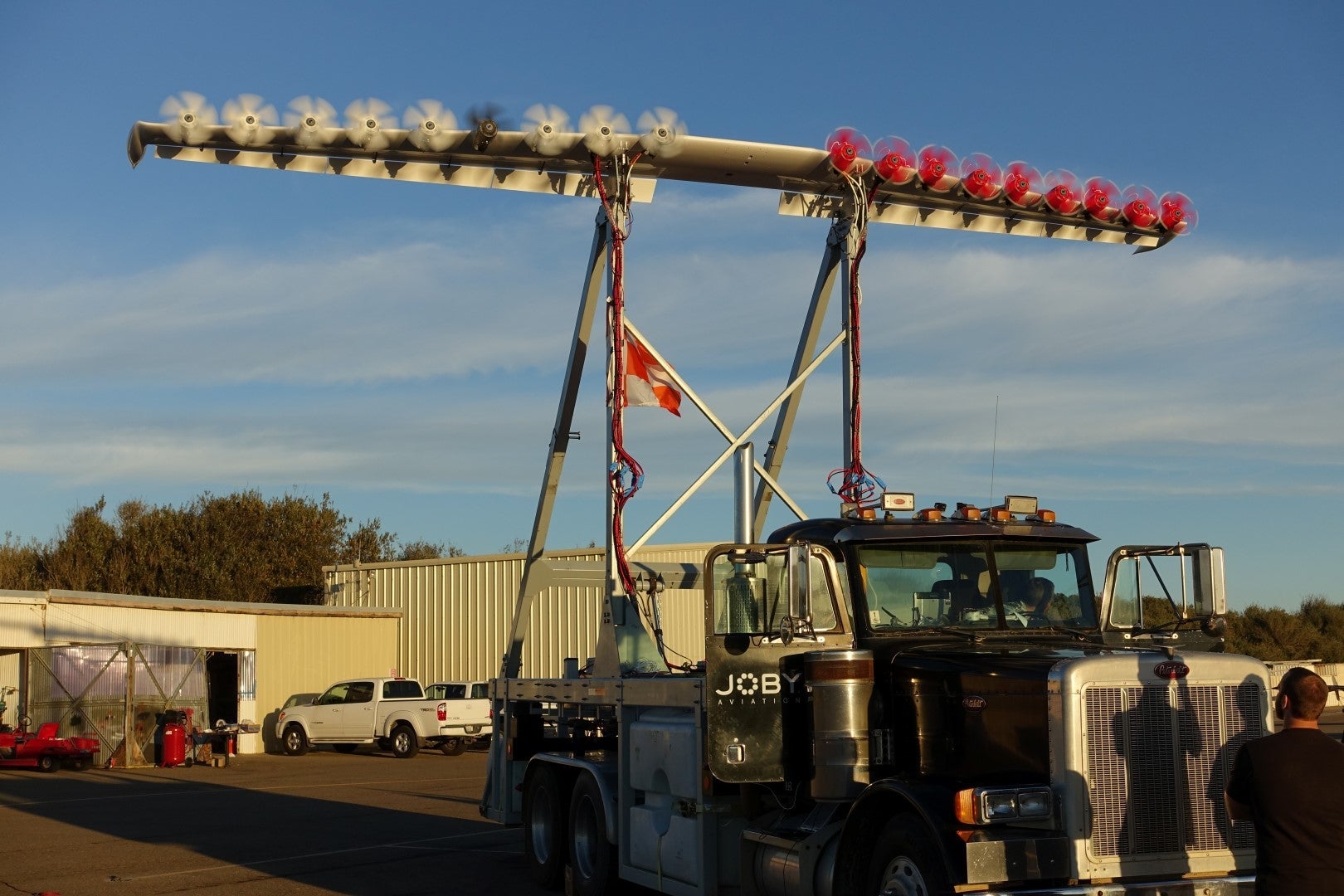
Nasa is preparing to conduct ground testing of a 31ft carbon composite wing section with 18 electric-powered motors, which could power future aircraft.
Electric motors will be powered by lithium iron phosphate batteries.

Discover B2B Marketing That Performs
Combine business intelligence and editorial excellence to reach engaged professionals across 36 leading media platforms.
Part of Nasa’s Leading Edge Asynchronous Propeller Technology (LEAPTech) project, the test is designed to demonstrate that tighter propulsion airframe integration with electric power will offer improved efficiency and safety.
Testing on the mobile ground rig assembly will assess researchers in future flight research, Nasa said.
Called the Hybrid-Electric Integrated Systems Testbed (HEIST), the experimental wing will be mounted on a customised truck and will be attached to load cells on a supporting component.
As part of the test, the truck will be driven at speeds of up to 70 miles per hour (mph) at Edwards Air Force Base. The wing recently completed a preliminary testing at speeds of up to 40mph at Oceano County Airport in California, US.

US Tariffs are shifting - will you react or anticipate?
Don’t let policy changes catch you off guard. Stay proactive with real-time data and expert analysis.
By GlobalDataThe experiment is predecessor to Nasa’s proposed development of a small X-plane demonstrator under its Transformative Aeronautics Concepts programme.
Nasa plans to install an improved version of the LEAPTech wing and motors on an Italian-built Tecnam P2006T for first flights within the next two years.
Nasa Langley Research Center aerodynamicist Mark Moore said: ""LEAPTech has the potential to achieve transformational capabilities in the near-term for general aviation aircraft, as well as for transport aircraft in the longer-term."
LEAPTech project is part of the agency’s plan to support the aircraft industry’s transition to electrical propulsion within the next decade. The technology could help reduce fossil fuels, improve aircraft performance and ride quality, as well as aircraft noise reduction.
Image: The experimental wing mounted on a customised truck will be driven at speeds of up to 70 miles per hour. Photo: courtesy of Joby Aviation.


