
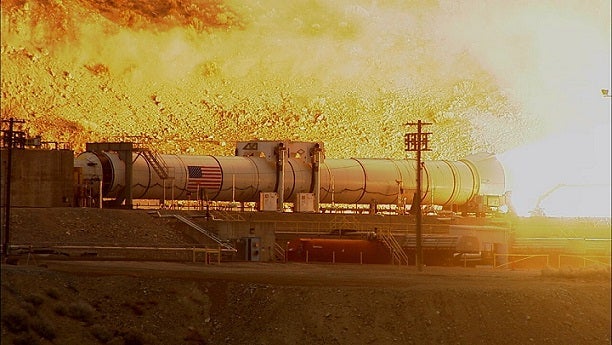
Nasa and Orbital ATK have completed the ground test of rocket booster that will propel the Space Launch System (SLS) rocket and Orion spacecraft to destinations beyond low-Earth orbit.
Carried out at Orbital ATK’s facility in Promontory, Utah, the ground test is the first of two tests planned to evaluate the booster for flight.

Discover B2B Marketing That Performs
Combine business intelligence and editorial excellence to reach engaged professionals across 36 leading media platforms.
During the test, the booster was fired for two minutes and generated 3.6 million pounds of thrust, Nasa said.
More than 531 instrumentation channels were monitored and the booster is said to comply with ballistic performance requirements such as thrust and pressure.
Data was collected for vital motor upgrades, including new internal motor insulation and liner and an improved nozzle design.
Nasa human exploration and operations associate administrator William Gerstenmaier said: "The work being done around the country today to build SLS is laying a solid foundation for future exploration missions, and these missions will enable us to pioneer far into the solar system.
US Tariffs are shifting - will you react or anticipate?
Don’t let policy changes catch you off guard. Stay proactive with real-time data and expert analysis.
By GlobalData"The teams are doing tremendous work to develop what will be a national asset for human exploration and potential science missions."
After the tests are qualified, flight booster hardware will shipped to Nasa’s Kennedy Space Center in Florida for the first SLS flight.
Nasa and Orbital ATK evaluated the booster at highest end accepted propellant temperature range of 90°F, and intend to conduct a cold-temperature test at a target of 40°F low end propellant temperature range early next year.
SLS programme manager Todd May said: "Our partnership with Orbital ATK and more than 500 suppliers across the country is keeping us on the path to building the most powerful rocket in the world."
The SLS will be powered by two five-segment boosters and four RS-25 main engines on deep space missions.
The first flight of the SLS vehicle with a 77t lift capacity is planned for 2017. It will carry an unscrewed Orion spacecraft beyond low-Earth orbit to evaluate the integrated system.
Last week, Nasa and Boeing completed vibration testing for SLS thrust vector control actuators with the Redstone Test Center’s Dynamic Test Division on Redstone Arsenal in Alabama, US.
Image: The booster for Nasa’s SLS rocket was fired for a two minute test at Orbital ATK Utah facility. Photo: courtesy of Nasa.


