
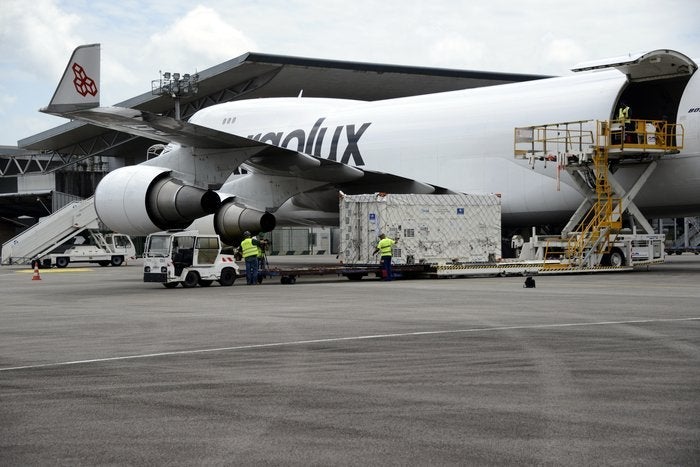
The ninth and tenth Galileo satellites have reached French Guiana to begin final preparations for launch aboard the Soyuz rocket in September.
The satellites landed at Cayenne-Félix Eboué Airport on a Luxair 747 aircraft and were then transported to Europe’s Spaceport.

Discover B2B Marketing That Performs
Combine business intelligence and editorial excellence to reach engaged professionals across 36 leading media platforms.
Named Flight Models 5 and 6 of the Full Operational Capability version, the navigation satellites started from the ESA’s ESTEC technical centre in Noordwijk, the Netherlands, following a series of tests to confirm their readiness for space.
The next two satellites are also midway through tests at ESTEC.
Germany-based OHB is currently working on 14 more satellites with its navigation payloads being supplied by Surrey Space Satellite Technology in Guildford, UK. Other parts have been sourced from across Europe.
Co-funded by the ESA and the European Commission, the Galileo programme is designed to provide an accurate global positioning system under European civilian control.
US Tariffs are shifting - will you react or anticipate?
Don’t let policy changes catch you off guard. Stay proactive with real-time data and expert analysis.
By GlobalDataThe ESA is managing design and procurement activities for the project, while the European Commission is providing funding.
Galileo is Europe’s global satellite navigation constellation with 30 satellites in medium earth orbit at an altitude of 23,222km.
Initial services by the constellation, including an encrypted public regulated service and a search-and-rescue function, are expected to commence by 2016.
The 24 operational satellites and six spares are planned to provide an encrypted commercial service through Galileo’s full operational capability phase by 2020.
In March, a Soyuz rocket lifted-off seventh and eighth Galileo satellites from French Guiana. Galileo pairs were previously launched in October 2011, October 2012 and August 2014.
Image: The ninth and tenth Galileo satellites being unloaded at Cayenne-Félix Eboué Airport. Photo: courtesy of ESA-P Muller.


