
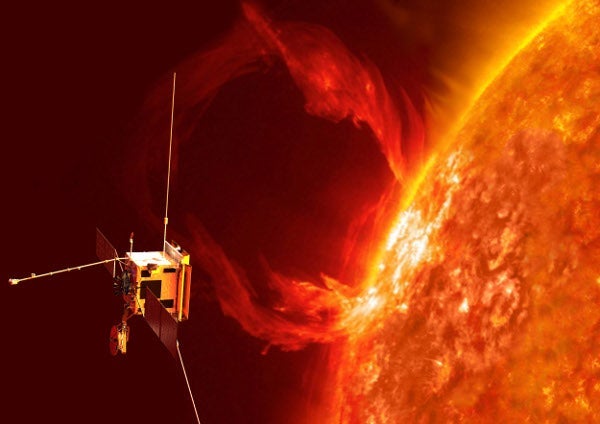
Astrium has been awarded a €300m contract by ESA to build a Solar Orbiter (SolO) spacecraft, which will explore the Sun much closer than before.

Discover B2B Marketing That Performs
Combine business intelligence and editorial excellence to reach engaged professionals across 36 leading media platforms.
ESA director of science and robotic exploration, Professor Alvaro Giménez Cañete, said: "It will help us understand how the Sun, essential to almost all life on Earth, forms the heliosphere and the origin of space weather, which can have an enormous influence on our modern civilisation."
SolO is expected to be launched in 2017 aboard a United Launch Alliance Atlas 5 rocket provided by NASA from Cape Canaveral in US.
Following the launch, the 1,800kg (3,968lb) SolO will travel deep into the inner Solar System, flying within 42 million km of the Sun and observe the solar wind before it gets disrupted.
Solar Orbiter, through its remote sensing imaging instruments, will examine the Sun’s creation and control of the heliosphere, the extended atmosphere of the Sun, and will capture images and measurements from inside the orbit of Mercury.
US Tariffs are shifting - will you react or anticipate?
Don’t let policy changes catch you off guard. Stay proactive with real-time data and expert analysis.
By GlobalDataThe spacecraft will reach its science orbit in 2020, and will further be routed to move closer to the Sun’s poles through the 2020s, gaining the first remote sensing imagery of the Sun’s highest latitudes.
The mission, which will last at least seven years, is designed to enhance the understanding of how the Sun influences its environment, and mainly how it generates and accelerates the flow of charged particles in which the planets are bathed.
ESA will provide the spacecraft and ground system, while the Member States of ESA and the US will fund about ten scientific instruments and NASA will provide one full instrument and one sensor.
The space company is planning to launch such a mission for the second time, Euclid, to study dark matter and dark energy in the universe, which will follow SolO in development and is planned to be launched in 2019.
Image: SolO will investigate the Sun’s creation and control of the heliosphere, and capture images to gain new insights of the star’s behaviour. Photo: ESA/AOES.


