
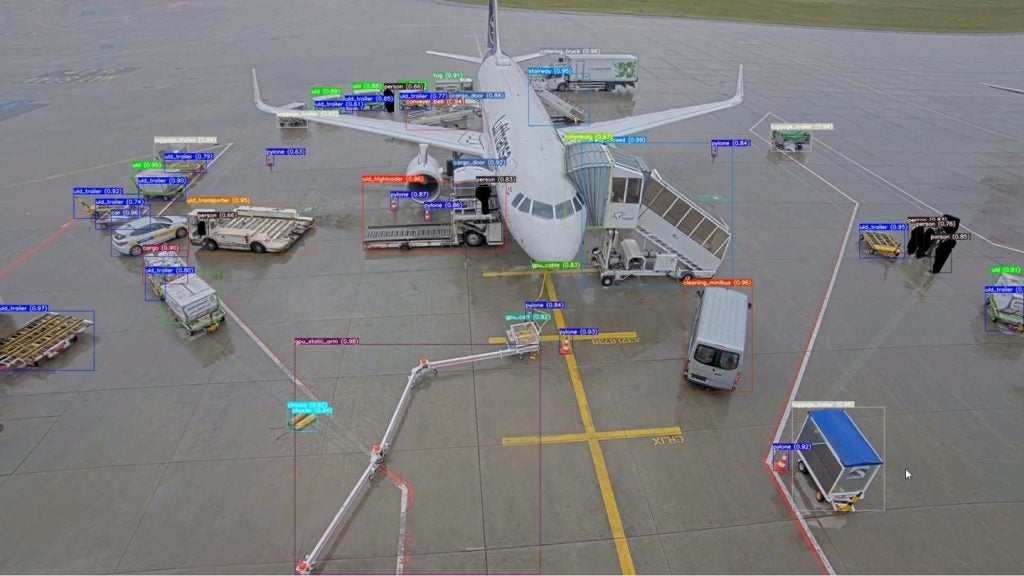
Lufthansa and Fraport have entered into a partnership aimed at enhancing aircraft handling efficiency at Frankfurt Airport through the introduction of an AI-based camera system named “seer.”
This initiative, which also involves Lufthansa's subsidiary zeroG, seeks to improve the transparency and punctuality of the aircraft turnaround process by utilising real-time data.
The “seer” system captures every aspect of the handling process, including the docking of passenger boarding bridges, baggage loading, and refuelling operations.
The AI technology automatically timestamps each step, thereby increasing the volume and quality of data collected.
This information is consolidated into a central database, referred to as a “single source of truth,” which facilitates better decision-making.
The development and pilot testing of the AI-supported turnaround process commenced in 2023.
From February to May 2024, the system was trialled at selected aircraft parking positions within Frankfurt Airport.
Currently, “seer” is operational at five parking positions, with plans to expand this to 20 by the end of the third quarter of this year. A comprehensive rollout across the airport is anticipated to follow.
Fraport CEO Stefan Schulte said: “At Fraport, we are driving forward a wide range of AI solutions to optimise processes at our airports, reduce the workload of our employees, and increase the satisfaction of our passengers and customers.”
Lufthansa is leveraging its operational expertise in conjunction with Fraport's knowledge of airport management.
Lufthansa Airlines CEO Jens Ritte said: “Transparent ground processes enable us to further improve our punctuality and service quality. This benefits our guests in particular.
“That is why we are working intensively on modernising our operational processes with innovative technologies such as the AI-based ‘seer’ solution.”
zeroG is responsible for integrating the AI and computer vision technology that underpins “seer,” ensuring it aligns with existing operational processes.
The implementation of this system is expected to benefit all airlines and system partners operating at Frankfurt Airport.
zeroG managing director Manuel van Esch said: “Aircraft don't earn money by being on the ground – yet this is where the most complex processes take place under intense time pressure.
“This is exactly where our solution helps: with the support of camera-based AI models, we make processes visible, analysable, and controllable – in real time.”
In April this year, Lufthansa Innovation Hub (LIH) and Munich Airport Terminal 2 signed a memorandum of understanding (MoU) to promote innovation in the aviation sector, addressing challenges such as operational efficiency, passenger experience, sustainability, and stability.