
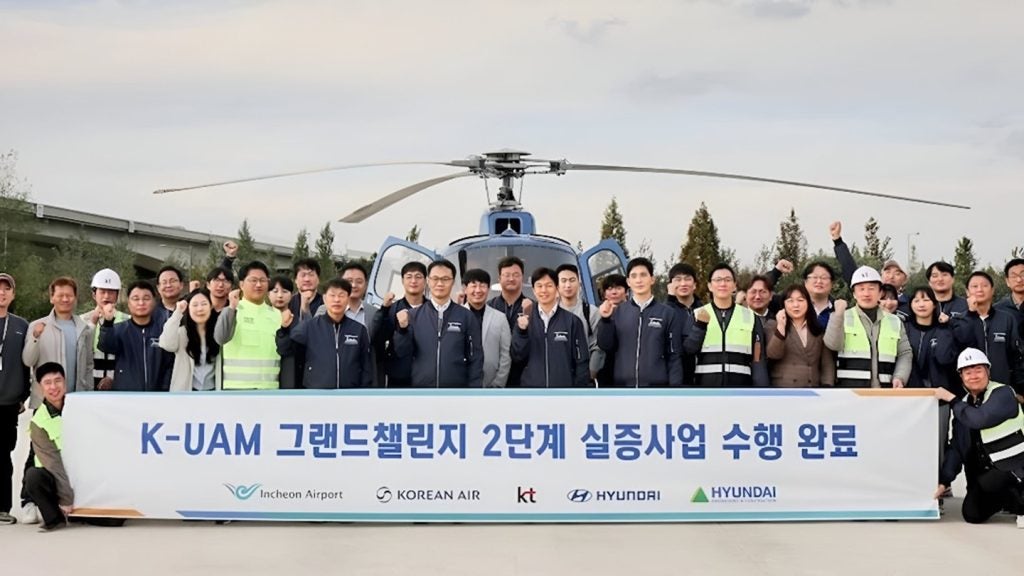
Korean Air has concluded Phase 2 of the Korean Urban Air Mobility (K-UAM) Grand Challenge, carrying out what is reported as South Korea’s first verified demonstration of urban air mobility operations in a metropolitan area.
The tests were conducted over a 12-day period from 16 to 31 October along the Ara Canal corridor between Seo-gu and Gyeyang-gu in Incheon, covering approximately 44.57km2 of airspace.
On 16 October, Korean Air, in collaboration with Incheon International Airport Corporation (IIAC) and telecommunications company KT, was designated as one of the country’s first UAM traffic management demonstration operators.
During the demonstration, Korean Air was responsible for flight operations control and traffic management.
The airline addressed safety risks associated with low-altitude urban flights, coordinated airspace handovers between multiple operators and traffic management systems for multi-route operations. It also tested operational stability during abnormal situations through simulation.
Korean Air deployed its proprietary Air Control & Routing Orchestrated Skyway System (ACROSS) platform for the demonstration.
The system provides real-time flight path monitoring, manages air traffic flow, and offers alternative routing in emergency scenarios.
The airline indicated it will continue to work with government and industry partners to support the commercialisation of UAM in South Korea and contribute to the development of a UAM ecosystem.
Korean Air also plans to further develop and automate the ACROSS platform through ongoing government-led research and development initiatives.
The K-UAM Grand Challenge is a national programme intended to verify safety and establish operational standards for urban air mobility commercialisation in South Korea.
Korean Air participates in the “K-UAM One Team” consortium, which includes Incheon International Airport Corporation, KT, Hyundai Motor, and Hyundai Engineering & Construction.
Last month, Korean Air agreed to commercialise Archer Aviation’s Midnight eVTOL in South Korea.
The partnership starts with government applications and will expand to multiple use cases. Korean Air may purchase up to 100 Midnight aircraft.
In April 2024, Korean Air completed the first demonstration of its full UAM system, using a 5G network to connect its internal UAM operations to an electric vertical takeoff and landing (eVTOL) aircraft.