
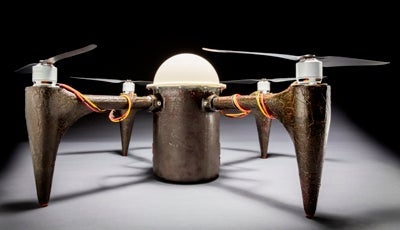
Researchers from Johns Hopkins University’s Applied Physics Laboratory (APL) in Laurel, Maryland, US, have developed a new unmanned aerial vehicle (UAV) that can operate effectively both in air and water.
The new Corrosion Resistant Aerial Covert Unmanned Nautical System (Cracuns) submersible UAV can stay on station underwater, and also be launched from an unmanned underwater vehicle (UUV) into the air to perform various missions.

Discover B2B Marketing That Performs
Combine business intelligence and editorial excellence to reach engaged professionals across 36 leading media platforms.
For developing the new design, a team from APL’s force projection sector collaborated with fabrication experts in the research and exploratory development department.
The Cracuns prototype system, which can be operated in the harsh littoral (shore) environment and several other missions due to its payload flexibility, was developed and tested using the university’s internal research and development funding.
APL sea control mission area project manager for Cracuns Jason Stipes said: "Engineers at APL have long worked on both Navy submarine systems and autonomous UAVs.
"In response to evolving sponsor challenges, we were inspired to develop a vehicle that could operate both underwater and in the air."
Cracuns has the ability to remain at and launch from a considerable depth without the support of structural metal parts or machined surfaces.
While designing the UAV, the APL team fabricated a lightweight, submersible, composite airframe that can survive the water pressure while submerged.
In order to ensure Cracuns’ effective operations in an acidic saltwater condition, the APL team sealed the most sensitive components in a dry pressure vessel and for the exposed motor parts, they used commercially available protective coatings.
The researchers tested the performance of the motors by submerging them in salt water and two months later, the motors were said to show no sign of corrosion and continued to work while submerged.
Image: Cracuns is a submersible UAV that can be launched from a fixed position underwater, or from an unmanned underwater vehicle (UUV). Photo: courtesy of Johns Hopkins APL.


