
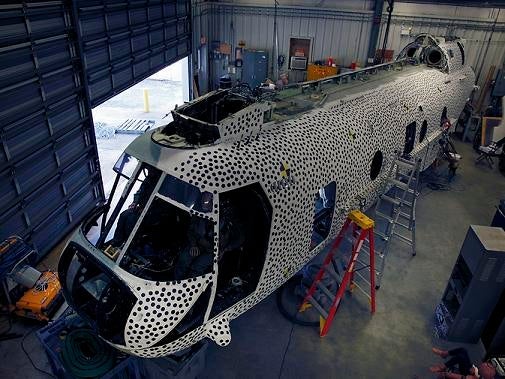
Researchers from Nasa are set to a conduct full-scale transport rotorcraft airframe crash test, to evaluate improvements on rotorcraft performance and efficiency.
Planned to be carried out at the agency’s Landing and Impact Research Facility at Langley Research Center, the study involves dropping a 45ft-long helicopter fuselage from an altitude of around 30ft.

Discover B2B Marketing That Performs
Combine business intelligence and editorial excellence to reach engaged professionals across 36 leading media platforms.
The crash test is part of the rotary wing project in the fundamental aeronautics programme of Nasa’s Aeronautics Research Mission Directorate, and follows a similar test conducted in August last year.
Lead test engineer Martin Annett said: "The big difference in this year’s experiment is that we are testing three energy absorbing composite subfloor concepts that should help some of the dummy occupants sustain fewer injuries than they did in the first test."
A CH-46 Sea Knight helicopter fuselage with 13 data-recording crash test dummies and two non-instrumented manikins will be used for the test.
The behaviour of these dummies and manikins during and after impact will be recorded using around 40 cameras inside and outside the helicopter.

US Tariffs are shifting - will you react or anticipate?
Don’t let policy changes catch you off guard. Stay proactive with real-time data and expert analysis.
By GlobalDataSome of the cameras will focus on the side of helicopter, which has painted black polka dots over a white background.
Test engineer Justin Littell said: "High-speed cameras filming at 500 images per second track each dot, so after the drop we can plot and see exactly how the fuselage buckled, cracked or collapsed under crash loads.
"During this test, we particularly want to see how well the composite subfloors absorb the energy of impact."
The crash tests are being supported by the US Navy, US Army, the Federal Aviation Administration, Cobham Mission Systems, German Aerospace Research Center (DLR) and the Australian Cooperative Research Center for Advanced Composite Structures.
Rotary Wing Project manager Susan Gorton commented: "The ultimate goal of Nasa rotary wing research is to help make helicopters and other vertical take-off and landing vehicles more serviceable, able to carry more passengers and cargo, quicker, quieter, safer and greener."
Image: A helicopter fuselage under preparation inside a Nasa Langley workshop for a crash test. Photo: courtesy of Nasa Langley / David C Bowman.



