
A consortium-led by British defence technology firm QinetiQ is working on new imaging technology, to design and manufacture current and future generations of carbon composite aircrafts.
The consortium comprises the University of Southampton, University College London (UCL) and four companies in ProjectCAN.

Discover B2B Marketing That Performs
Combine business intelligence and editorial excellence to reach engaged professionals across 36 leading media platforms.
The three-year project brings together academia, the aerospace industry and X-ray inspection equipment manufacture.
Innovate UK provided funding to develop two non-destructive testing processes to detect errors in composite aerospace components.
As part of the project, University of Southampton’s µ-VIS Centre for Computed Tomography and Nikon Metrology UK will work together on scanning and visualising the insides of large, flat components using X-rays.
The partners will use a laminography system and an algorithm to accumulate scan data and reconstruct it into a 3D volume image.

US Tariffs are shifting - will you react or anticipate?
Don’t let policy changes catch you off guard. Stay proactive with real-time data and expert analysis.
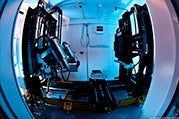
By GlobalDataHardware and software will be developed by ProjectCAN to allow laminographic imaging within the Nikon Metrology 225 / 450kV X-ray scanner at the µ-VIS centre.
University of Southampton µ-VIS x-ray imaging centre deputy director Thomas Blumensath said: "We will be developing an alternative technique, which applies computed laminography (CL) techniques, to overcome the limitations of conventional CT for large, flat components.
"This will enhance our ability to find defects in large composite parts, such as those which are increasingly used in modern aircraft.
"This will ultimately help in the production and maintenance processes, and will assist in the development of more environmentally-friendly aeroplanes, as well as enhanced overall aircraft safety."
CL systems are said to implement linear translation or limited-angle rotation to scan components.
Axi-Tek and UCL will develop a new backscatter x-ray inspection technique to study large area composite structures such as wing sections, engine cowlings and fuselage components.
Image: Nikon Metrology 225/450kV X-ray scanner. Photo courtesy of University of Southampton.


