

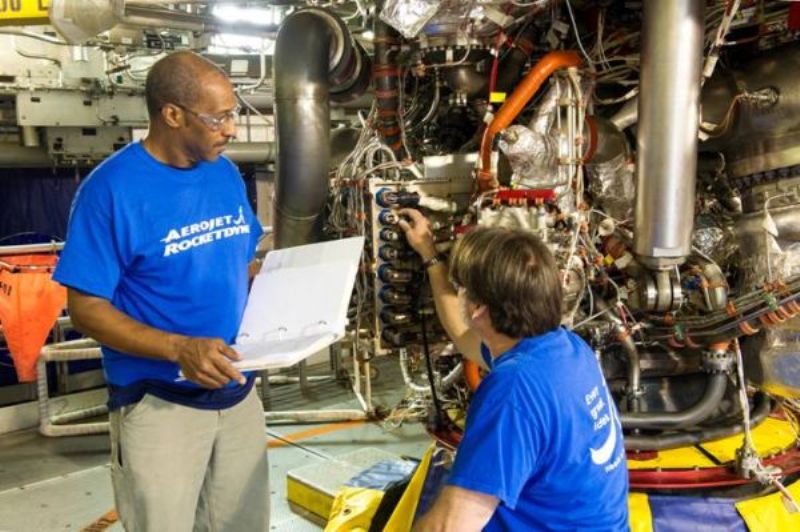
Aerojet Rocketdyne has tested its RS-25 engine controller on a RS-25 development engine at Nasa’s Stennis Space Centre in Mississippi, US.
Featuring a new flight-model engine controller and flight configuration software, the RS-25 will be used to thrust Nasa's Space Launch System (SLS) rocket, a next-generation heavy-lift launch vehicle.

Discover B2B Marketing That Performs
Combine business intelligence and editorial excellence to reach engaged professionals across 36 leading media platforms.
Nasa is planning to send humans on the SLS, which will be equipped with four RS-25 engines, to deep space and the surface of Mars.
Referred to as the ‘brain’ of the engine, the newly tested controller is designed to translate the SLS vehicle's commands into engine action, as well as monitor the health of the engine.
The controller also helps to make real-time adjustments by tracking critical operating conditions such as turbopump speeds, combustion pressures and temperatures, in addition to thrust and propellant ratios.
The controller is also an upgraded version of the controller used in Aerojet Rocketdyne's J-2X latest engine test programme.

US Tariffs are shifting - will you react or anticipate?
Don’t let policy changes catch you off guard. Stay proactive with real-time data and expert analysis.
By GlobalDataThe new controller has 20 times more processing capability than the controller used in the test programme, and can reduce the weight of each engine by 50lb.
Aerojet Rocketdyne RS-25 programme director Dan Adamski said: “Just think about all the advances in computing technology and electronics that have occurred over the recent years, we've been able to include those advances into the controller.
“We've been able to increase the processing speed, add memory and greatly improve the reliability of the entire controller communication network.”
Earlier this month, Aerojet Rocketdyne had completed the hot-fire acceptance testing of eight auxiliary engines.
The engines will be used on the first flight of Nasa's Orion spacecraft with the SLS rocket, which is set to launch next year.
Image: Aerojet Rocketdyne technicians inspect the new controller on the RS-25 development engine. Photo: courtesy of Aerojet Rocketdyne.


