


CBTA for ATCO Training: Turning New Regulation into Better Outcomes
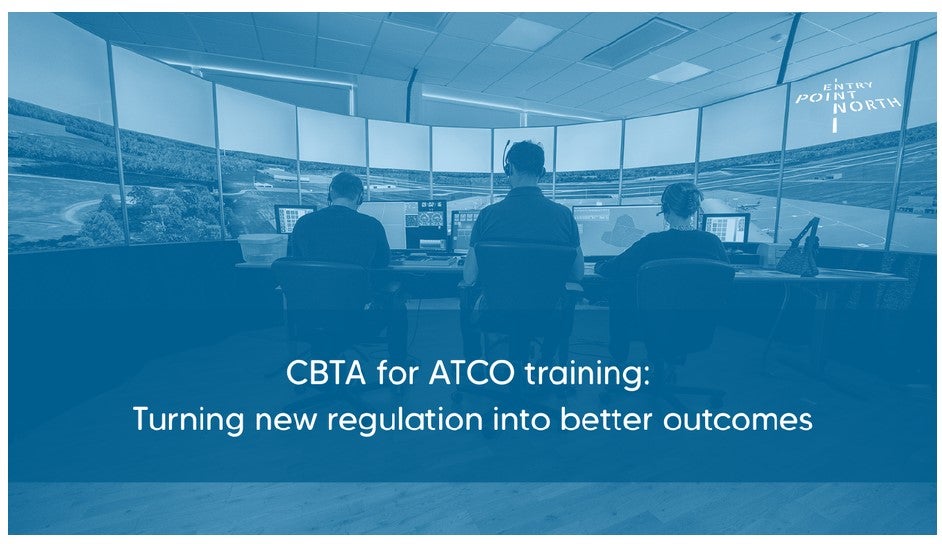
If you are responsible for ATCO training, Competency Based Training and Assessment (CBTA) is already on your radar. With the new EU regulation on ATCO training adopted in October 2025, all Member States must align their ATCO training with a CBTA approach by 1 January 2029.
The key question is no longer ‘What is CBTA?’, it is:
How do we redesign our training, upskill our instructors and document competence in a way that works in our local context, while staying compliant and operational?
How Entry Point North supports CBTA implementation
Entry Point North has worked with CBTA-based approaches in training design and delivery for over a decade. Today, we support ANSPs at different stages of their implementation journey by:
- Designing and adapting competency models
- Facilitating workshops and providing expert input to help you build a robust, locally adapted competency framework.
- Upskilling instructors and assessors
- Through courses such as our Practical Instructor Refresher, with CBTA as a key topic focusing on observable behaviours, structured feedback and consistent assessment.
- Reviewing and redesigning existing training
- Analysing current courses and aligning objectives, content, scenarios and assessments with your competency model.
- Strengthening implementation and quality assurance
- Advising on how to document CBTA in Training Specifications, assessment processes and quality systems to provide clear evidence for audits and oversight.
CBTA is a journey, not a one-off project. Our role is to share what we have learned so far and to help ANSPs turn regulatory requirements into better training, stronger competence and safer operations.
From regulation to daily practice: what CBTA really means
At its core, CBTA is about aligning training with the real competencies required for the job.
Instead of focusing mainly on hours, CBTA starts from the question: What must air traffic controllers be able to do, in context, for operations to be safe and efficient? Training and assessment are then designed around those competencies. The new EU regulation amending Regulation (EU) 2015/340 introduces CBTA into ATCO training, with implementation required by 1 January 2029. For ANSPs and training organisations, this is more than a compliance exercise. It implies:
- Training redesign- Existing training structures, performance objectives and assessments need to be reviewed and aligned with CBTA logic, from basic training to unit training and continuation training.
- Instructor and assessor upskilling- Instructors and assessors must be comfortable working with competency frameworks, behavioural indicators and structured assessment reports.
- Improved work processes- CBTA supports better decision-making in training, clearer expectations for trainees and more meaningful feedback for operational units. It enables the training system to be both effective and efficient, with a safe outcome.
The goal is not only to ‘tick the box’ of a new regulation; it is to use CBTA to make training more transparent, targeted and impactful, and to align training throughout Europe.
Insights from the CBTA Implementation Workshop in Paris
Recently, Entry Point North participated as facilitators in a CBTA Implementation Workshop in Paris that brought together ANSPs and training organisations to translate the new regulation into daily practice.
Three elements stood out in particular:
- Structured walk-through of the new regulation- Step-by-step guidance on what the new CBTA requirements mean, with a focus on unit training, and how they connect to existing rules for ATCO licensing and training organisations.
- Hands-on work on competency models- In smaller breakout groups, participants worked with practical exercises to adapt competency models to a local context.
- Peer learning across organisations- Open sharing of experiences, challenges and lessons learned between participants who are at different stages of CBTA implementation.
Together, this gave a very concrete picture of CBTA in real training environments, not just on paper.
Three first steps for ANSPs starting now
For ANSPs starting their CBTA journey this quarter, three early steps are essential:
- Analyse the training need and define the Training Specification- Get a clear, documented view of what roles you are training for, what operational context they work in and what performance is required. This is the foundation for all later design work.
- Design a locally adapted Competency Model- Take the generic competency framework and tailor it to your organisation, your units and your operational reality. The model should be specific enough to guide training and assessment, but flexible enough to stay usable over time.
- Decide how you will work with Assessment Reports- Clarify formats, criteria, rating scales and responsibilities. Assessment reports are a key tool in CBTA. They must support both fair decisions about competence and constructive feedback for development.
Across all three steps, one factor is critical for success: engaged instructors and assessors. If they are not involved and on board, even the best-designed competency model will remain a paper product.
Get in touch
If you would like to discuss how CBTA will impact your training organisation or where you are in your implementation journey, we are happy to talk.
Get in touch with us to explore how Entry Point North can support your CBTA implementation.