
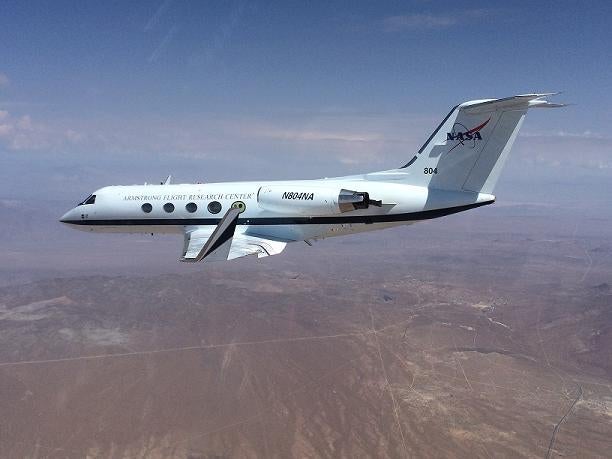
Nasa has completed test flights of a new morphing wing technology, which could help reduce airframe weight and also decrease aircraft noise during takeoff and landing.
For the study, the agency partnered with the Air Force Research Laboratory (AFRL) and FlexSys.

Discover B2B Marketing That Performs
Combine business intelligence and editorial excellence to reach engaged professionals across 36 leading media platforms.
During the past six months, Nasa has conducted 22 research flights at Armstrong Flight Research Center in Edwards, California, with experimental adaptive compliant trailing edge (ACTE) flight control surfaces.
The ACTE technology is claimed to reduce wing structural weight and aerodynamically alter the wings, to facilitate fuel efficiency and efficient operations. It can be installed on existing aircraft wings or integrated into new airframes.
Nasa environmentally responsible aviation (ERA) project manager Fay Collier said: "This is the first of eight large-scale integrated technology demonstrations ERA is finishing up this year that are designed to reduce the impact of aviation on the environment."
The flight testing is designed to demonstrate the airworthiness of the technology, Nasa said.
As part of the tests, the experimental control surfaces were evaluated at various flap angles from -2° to 30°.
The ACTE flaps can morph throughout the flight. However, the flaps were tested at a single fixed setting to accumulate data with a minimum risk.
Since 1998, AFRL and FlexSys have been working together on wing technologies and have since developed and wind tunnel-tested various designs for multiple aircraft configurations.
In 2009, AFRL and Nasa agreed to test FlexSys-built ACTE flaps on a Gulfstream III jet.
AFRL Wright-Patterson Air Force Base Ohio programme manager Pete Flick said: "These flights cap 17 years of technology maturation, beginning with AFRL’s initial phase one SBIR contract with FlexSys, and the technology now is ready to dramatically improve aircraft efficiency for the Air Force and the commercial aviation industry."
Nasa said that the results from these flight tests will facilitate design trade studies performed at its Langley Research Center in Virginia, to design future large transport aircraft.
Image: Nasa evaluated the experimental control surfaces at various flap angles from -2° to 30°. Photo: courtesy of Nasa.


