
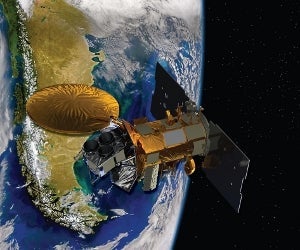
Nasa’s ocean salinity study mission has ended after the Satélite de Aplicaciones Científicas, SAC-D, satellite observatory stopped working due to technical problems.
The SAC-D system was carrying Nasa’s Aquarius instrument for studying the ocean surface salinity in order to link the water cycle and ocean circulation for more accurate computer climate models.

Discover B2B Marketing That Performs
Combine business intelligence and editorial excellence to reach engaged professionals across 36 leading media platforms.
Nasa said that an ‘essential part’ of the power and altitude control system of the spacecraft stopped working on 8 June.
An on-board hardware component called a remote terminal unit (RTU) is suspected to have shutdown, causing loss of power regulation and destabilising the spacecraft’s altitude.
Launched in June 2011 from Vandenberg Air Force Base, California, the mission was a collaboration between Nasa and Argentina’s space agency Comisión Nacional de Actividades Espaciales (Conae).
Conae has provided the SAC-D spacecraft with an optical camera, a thermal camera in collaboration with Canada, a microwave radiometer, and sensors developed by various Argentine institutions.
France and Italy have also contributed instruments to the mission, whose operations centre is located in Argentina.
The system failure will, however, not affect Aquarius’ job as it has completed its primary three-year mission last year.
Data gathered by the instrument has helped scientists understand the interaction between the freshwater sources, the ocean, atmosphere and sea ice, which, in turn, influences ocean circulation, weather and climate.
According to Nasa, Aquarius’ surface salinity measurements are assisting in better understanding of ocean dynamics and developing advanced climate and ocean models. These models are improving El Niño prediction.
Aquarius Earth & Space Research, Seattle, principal investigator Gary Lagerloef said: "The Aquarius sensor collected three years and nine months of valuable data.
"It was truly a pioneering effort to determine how accurately we could measure ocean salinity from space and for the first time study large and small-scale interactions of the global watercycle."
Image: An artist’s impression of the SAC-D spacecraft. Photo: courtesy of Nasa.


