
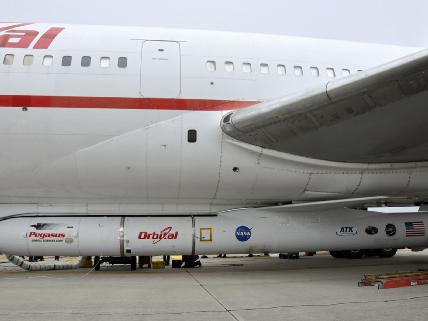
 Orbital Sciences has successfully launched NASA’s Nuclear Spectroscopic Telescope Array (NuSTAR) satellite aboard Pegasus rocket from the Ronald Reagan Test Site at Kwajalein Atoll in the Pacific Ocean.
Following the launch towards a circular orbit nearly 400 miles above the Earth, the Orbital-built spacecraft will study high energy X-rays in the universe, black holes, and plot supernova explosions, as well as explore intense active galaxies and the Sun’s atmosphere.

Discover B2B Marketing That Performs
Combine business intelligence and editorial excellence to reach engaged professionals across 36 leading media platforms.
The NuSTAR satellite project is part of NASA’s Small Explorer (SMEX) series; it is expected to collect critical data regarding the Earth’s environment, the solar system and beyond.
California Institute of Technology mission principal investigator Fiona Harrison said: "NuSTAR will help us find the most elusive and most energetic black holes, to help us understand the structure of the universe."
The mission’s observations will assist in solving primary cosmic mysteries. It will receive support from other telescopes, such as NASA’s Chandra X-ray Observatory, which detects lower-energy X-rays.
ATK has provided propulsion for the Pegasus rocket’s three stages, in addition to the solar array and structures comprising 33ft-long deployable ABLE deployable articulated mast (ADAM) and adjustment system for the NuSTAR spacecraft.

US Tariffs are shifting - will you react or anticipate?
Don’t let policy changes catch you off guard. Stay proactive with real-time data and expert analysis.
By GlobalDataNuSTAR is claimed to be more powerful than its predecessors due to its capability of focussing high-energy X-ray light through 133 nested shells of mirrors, which avoid the light from reflecting off.
The telescope also features modern detectors and its long mast, which connects the optical units to the detectors, enabling sufficient distance for a sharp focus.
Led by the California Institute of Technology, NuSTAR mission is handled by NASA’s Jet Propulsion Laboratory for the agency’s Science Mission Directorate.
Image: NuSTAR satellite was fitted beneath Orbital’s Stargazer L-1011 carrier aircraft prior to the launch. Photo: courtesy of NASA/Randy.


