
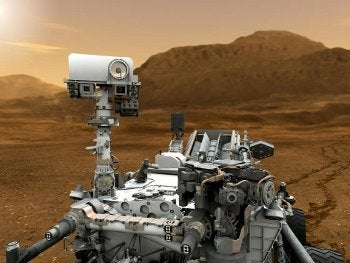
NASA’s Curiosity rover will examine Martian rock for the first time tomorrow after landing on the red planet more than a month ago.
The rover is around 2.5m away from the rock, which lies about halfway from Bradbury Landing, the site where Curiosity landed, and Glenelg, a location where three terrains intersect.

Discover B2B Marketing That Performs
Combine business intelligence and editorial excellence to reach engaged professionals across 36 leading media platforms.
Curiosity rover, which has driven 289.5m away from the landing site so far, will pause for some days to photograph the pyramid shaped rock.
The vehicle’s Mars Hand Lens Imager will take the pictures, while its Alpha Particle X-ray Spectrometer will examine the rock’s chemical composition.
The rock is about 10in high and 16in wide at the base. It has been named in honour of Jacob Matijevic, who was the surface operations systems chief engineer for the Mars Science Laboratory (MSL) and also of the project’s Curiosity rover.
Curiosity now has driven for six consecutive days and covered a distance 22m and 37m each day.

US Tariffs are shifting - will you react or anticipate?
Don’t let policy changes catch you off guard. Stay proactive with real-time data and expert analysis.
By GlobalDataAfter taking a break to study the first rock, the rover will move towards Glenelg, where it will pick another suitable rock and use its systems to analyse powder drilled from the interiors of rocks.
The Glenelg area has three different terrains, one lighter-toned and another more heavily cratered than the area the rover currently is passing through.
It is the lighter-toned area that NASA scientists have great interest in, as it retains daytime heat even into the night, indicating that it could have a very different geological makeup from the rest of the vicinity.
From Glenelg, the Curiosity’s final destination will be towards the base of Mount Sharp, at the heart of Gale Crater, to look for clues on the geological history of Mars, and this journey could take about three months.
On a two-year mission, the vehicle will investigate if it is possible to live on Mars and determine if the planet was ever habitable.
Image: An artist’s impression of NASA’s Curiosity rover, which is set to study the first Martian rock tomorrow. Photo: courtesy of NASA.


