
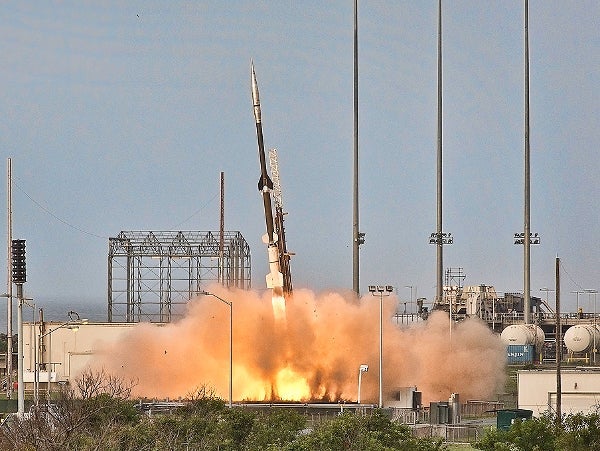
NASA has successfully tested a new inflatable heat shield equipped on the Inflatable Re-entry Vehicle Experiment (IRVE-3) spacecraft for its survival during its re-enterering Earth’s atmosphere at hypersonic speeds of nearly 7,600mph.
Launched aboard a three-stage Black Brant rocket for its suborbital flight from NASA’s Wallops Flight Facility, the test was aimed at demonstrating the spacecraft’s use of an inflatable outer shell to slow and protect itself when entering the atmosphere.

Discover B2B Marketing That Performs
Combine business intelligence and editorial excellence to reach engaged professionals across 36 leading media platforms.
The new inflatable heat shield was developed by NASA’s Space Technology Program.
NASA Space Technology Program deputy director James Reuther said that the initial results indicated the successful test of the hypersonic inflatable aerodynamic decelerator.
"This demonstration flight goes a long way towards showing the value of these technologies to serve as atmospheric entry heat shields for future space [travel]," Reuther said.
Following the launch, the 680lb inflatable aeroshell and the payload separated from the launch vehicle nearly 280 miles over the Atlantic Ocean.

US Tariffs are shifting - will you react or anticipate?
Don’t let policy changes catch you off guard. Stay proactive with real-time data and expert analysis.
By GlobalDataDuring its descent towards Earth’s atmosphere, an inflation system pumped nitrogen into the IRVE-3 aeroshell until it expanded to 10ft in diameter, and then the aeroshell plunged at hypersonic speeds.
NASA Langley Research Center in Hampton, Virginia, director Lesa Roe said a team of NASA engineers and technicians had spent the last three years preparing for the IRVE-3 flight.
"We are pushing the boundaries with this flight," Roe said.
NASA said that the information obtained from the testing would assist the researchers in developing future inflatable heat shield designs.
The test was a follow on to the earlier IRVE-2 test, which successfully demonstrated the unharmed survival of an inflatable heat shield following its entry into Earth’s atmosphere.
IRVE-3, with the same size as IRVE-2 but heavier than the predecessor design, was subjected to a much higher re-entry heating than its predecessor.
The IRVE-3 is developed and managed by Langley, which also manages HIAD programmes. IRVE-3 is part of the Hypersonic Inflatable Aerodynamic Decelerator (HIAD) Project within the Game Changing Development Program, and forms part of NASA’s Space Technology Program.
Image: Launch of IRVE-3 from NASA’s Wallops Flight Facility in Virginia, US. Photo: courtesy of NASA/Sean Smith.


