
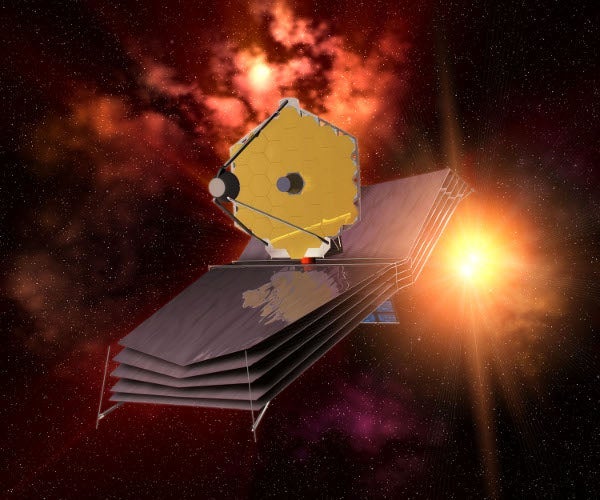
 NASA has received the first of four instruments, the mid-infrared instrument (MIRI), for the agency’s James Webb Space Telescope (Webb) at Goddard Space Flight Center, following an inspection.
Following its launch, MIRI will examine light with the mid-infrared range wavelengths from five microns to 28 microns and is claimed to be the only instrument of the four with unique monitoring ability of physical processes taking place in the cosmos.

Discover B2B Marketing That Performs
Combine business intelligence and editorial excellence to reach engaged professionals across 36 leading media platforms.
Goddard Space Flight Center ISIM project scientist Matt Greenhouse said that MIRI would enable Webb to distinguish the oldest galaxies from more evolved objects that have undergone several cycles of star birth and death.
"MIRI will provide a unique window into the birth places of stars, which are typically enshrouded by dust that shorter wavelength light cannot penetrate," Greenhouse added.
According to NASA, the instrument’s sensitive detectors will enable it to observe light, cool stars in very far-away galaxies, reveal newly forming stars within the Milky Way, discover marks of the planet formation around stars and capture images to allow studying an object’s shape and structure.
MIRI will also provide spectroscopy of the existing planets, comets and the farthest debris in the solar system.
US Tariffs are shifting - will you react or anticipate?
Don’t let policy changes catch you off guard. Stay proactive with real-time data and expert analysis.
By GlobalDataAssembled at and shipped from the Technology Facilities Council’s Rutherford Appleton Laboratory in the United Kingdom, MIRI has been developed by a consortium of ten European institutions and NASA’s Jet Propulsion Laboratory (JPL).
Webb Telescope, claimed to be the most powerful space telescope ever built, is follow-up to NASA’s Hubble Space Telescope and is a joint venture project of NASA, the European Space Agency (ESA) and the Canadian Space Agency.
NASA said that all the four instruments of the telescope would help reveal the development of universe from the Big Bang to the Solar System formation.
Image: James Webb Space Telescope will capture images of planet formation around stars and allow scientists to examine the object’s shape and structure. Photo: courtesy of ESA.


