
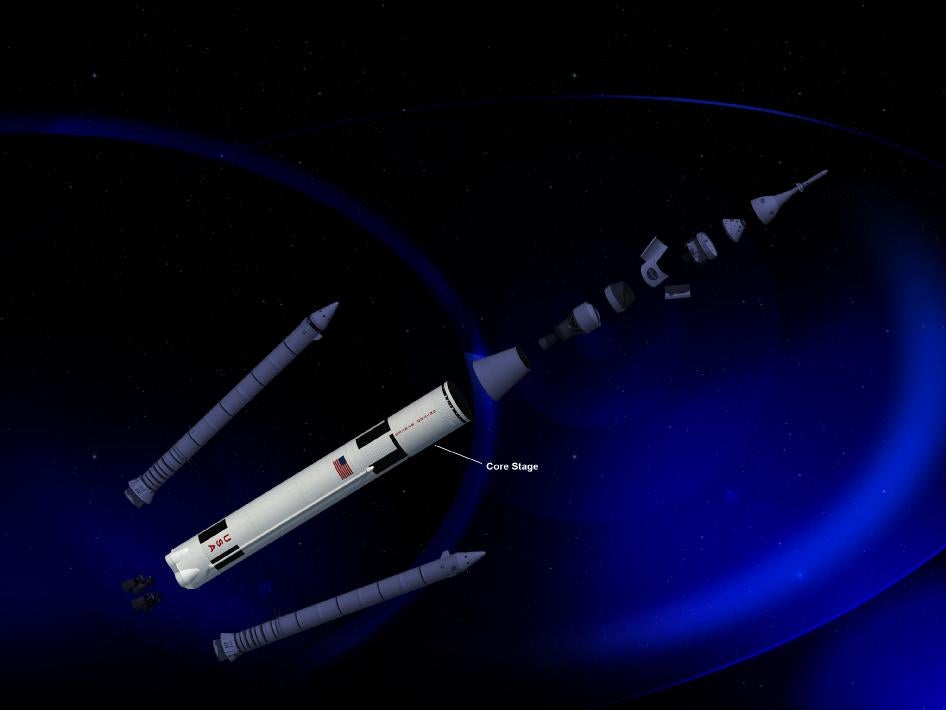
NASA’s Space Launch System (SLS) programme has successfully passed its system requirements and definition reviews, marking the completion of the its concept development phase.
Designed to provide human exploration beyond low Earth orbit, the SLS will launch NASA’s Orion spacecraft and other payloads.

Discover B2B Marketing That Performs
Combine business intelligence and editorial excellence to reach engaged professionals across 36 leading media platforms.
William Gerstenmaier, NASA Headquarters Human Exploration and Operations Mission Directorate associate administrator, said that the new heavy-lift launch vehicle would make it possible for explorers to reach beyond the agency’s current limits, to nearby asteroids, Mars and its moons, as well as further destinations in the solar system.
"The in-depth assessment confirmed the basic vehicle concepts of the SLS, allowing the team to move forward and start more detailed engineering design," Gerstenmaier added.
The reviews determine technical, performance, cost and schedule requirements, which help to develop the heavy-lift rocket on schedule.
According to NASA, the ten month reviews have also confirmed the architecture and integration of SLS system with the Orion spacecraft.
US Tariffs are shifting - will you react or anticipate?
Don’t let policy changes catch you off guard. Stay proactive with real-time data and expert analysis.
By GlobalDataThe initial test flight of NASA’s Space Launch System, featuring a configuration for a 77t lift capacity, is scheduled for 2017.
With further development, the three-stage SLS launcher configuration will offer a 143t lift capability, which will allow the performing of deep space exploration missions beyond low Earth orbit.
NASA’s Stennis Space Center in Mississippi, US, will test the SLSs RS-25 core stage and J-2X upper-stage rocket engines, currently under development by Pratt & Whitney Rocketdyne.
ATK is the prime contractor for the launcher’s five-segment solid rocket boosters, while Boeing is designing the core stage of SLS.
The SLS will now move ahead towards the preliminary design phase, which is expected to take place in the latter part of 2013.
Image: An artist impression of NASA’s SLS 70t configuration, which is managed by the Marshall Space Flight Center in Huntsville, Alabama, US. Photo: courtesy of NASA.


