
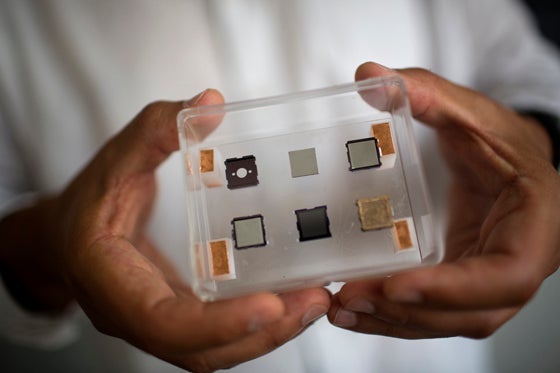
Researchers at Massachusetts Institute of Technology in the US have developed penny-sized ‘microthrusters’ that could propel 2lb satellites through space.
The new propelling system is a flat, compact square, similar to a computer chip. It houses 500 microscopic tips which emit tiny beams of ions when stimulated with voltage.

Discover B2B Marketing That Performs
Combine business intelligence and editorial excellence to reach engaged professionals across 36 leading media platforms.
MIT associate professor of aeronautics and astronautics Paulo Lozano said the microthrusters are so small that it is possible to put several thrusters on a vehicle, adding that a small satellite outfitted with several microthrusters could "not only move to change its orbit, but do other interesting things – like turn and roll".
Developed at MIT’s Space Propulsion Laboratory and Microsystems Technology Laboratory through the use of micro-manufacturing techniques, the mini ion thrusters have completed several tests.
There are currently about two dozen CubeSats, small satellites, in Earth’s orbit, each weighing less than 3lbs, but they lack propulsion systems and burn up in the lower atmosphere when their missions are complete.
Lozano warns that if CubeSats are launched into higher orbits in future they will take longer to degrade, and could remain in orbit as space clutter.

US Tariffs are shifting - will you react or anticipate?
Don’t let policy changes catch you off guard. Stay proactive with real-time data and expert analysis.
By GlobalData"These satellites could stay in space forever as trash," Lozano said.
"This trash could collide with other satellites. … You could basically stop the Space Age with just a handful of collisions."
According to the researchers, microthrusters can assist in moving the small satellites closer to Earth, allowing them to burn up.
"Just like solar panels you can aim at the sun, you can point the thrusters in any direction you want, and then thrust," Lozano said.
Image: Mini ion thrusters are produced using micro-manufacturing techniques. Photo: M. Scott Brauer


