
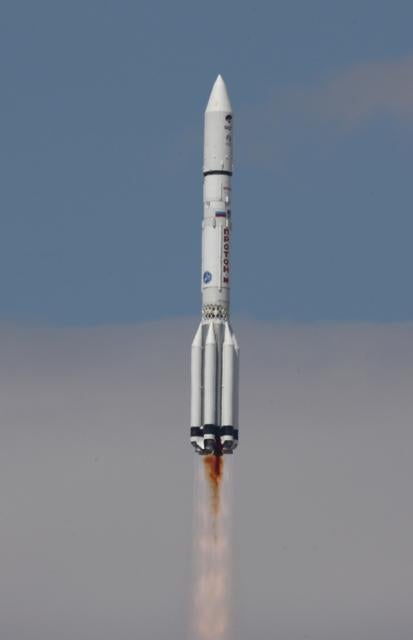
Telecommunications satellite SES-6 has been launched from the Baikonur Cosmodrome in Kazakhstan aboard the International Launch Services (ILS) Proton vehicle.
After a 15-hour, 31-minute mission, the SES-6 satellite was successfully placed into geostationary transfer orbit by the Breeze M upper stage of the Proton rocket, a development that marks the completion of second super-synchronous transfer orbit (SSTO) mission with the Proton vehicle for ILS.

Discover B2B Marketing That Performs
Combine business intelligence and editorial excellence to reach engaged professionals across 36 leading media platforms.
Featuring 48 Ku-band and 43 C-band transponders, the SES-6 is built on Astrium’s E3000 platform and weighed more than 6t at the time of liftoff.
It is designed for 13kW of spacecraft power at the end of its 15-year lifetime.
The SSTO mission employed a 5-burn Breeze M mission design to raise the orbital unit first to a circular parking orbit, then to an intermediate orbit, followed by a transfer orbit, and to a super-synchronous transfer orbit.
These missions are capable of providing customers with increased performance, enabling maximisation of operational lifetime of spacecraft.
US Tariffs are shifting - will you react or anticipate?
Don’t let policy changes catch you off guard. Stay proactive with real-time data and expert analysis.
By GlobalDataThe SES-6 is the fourth mission to be launched by ILS as part of a multi-launch agreement (MLA) signed in June 2007 between SES and ILS.
It is the 22nd SES satellite launched on an ILS Proton and the 16th Astrium-built satellite launched on ILS Proton Breeze M vehicle, which was developed by Khrunichev State Research and Space Production Center of Moscow.
The satellite is planned to replace the existing NSS-806 at the prime orbital location 40.5° W, and will provide enhanced capacity over North and South America, the Caribbean, Europe and the Atlantic Ocean regions.
The expanded payload of the satellite will also support direct-to-home (DTH) and very small aperture terminal (VSAT) platforms in emerging markets.
Following the launch, SES announced the Brazilian telecommunication firm Oi as a new anchor customer, which signed a long-term agreement to provide DTH services in Brazil, a development that makes Oi the largest user of the new satellite.
Image: The SES-6, which is built on Astrium’s E3000 platform, carried 48 Ku-band and 43 C-band transponders and weighed more than 6t at liftoff. Photo: courtesy of ILS International Launch Services Inc.



