
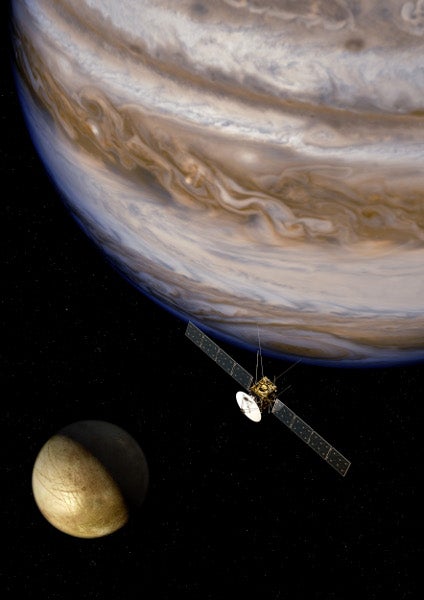
The European Space Agency (ESA) has approved a €1bn space mission to explore the icy moons of the planet Jupiter.

Discover B2B Marketing That Performs
Combine business intelligence and editorial excellence to reach engaged professionals across 36 leading media platforms.
The Jupiter Icy Moons Explorer mission (JUICE) is part of the agency’s Cosmic Vision 2015-2025 programme and is expected to be launched in 2022, aboard an Ariane 5 launcher from its Kourou launch centre in French Guiana.
ESA Science and Robotic Exploration director professor Alvaro Giménez Cañete said JUICE will provide better insight into how gas giants and their orbiting worlds form, and their potential for hosting life.
"JUICE is a necessary step for the future exploration of our outer Solar System," said Cañete.
ESA has selected JUICE over two other projects, in the New Gravitational wave Observatory (NGO), designed to track gravitational waves, and the Advanced Telescope for High-Energy Astrophysics (ATHENA), which is expected to be considered for future launches.

US Tariffs are shifting - will you react or anticipate?
Don’t let policy changes catch you off guard. Stay proactive with real-time data and expert analysis.
By GlobalDataFollowing its launch, the spacecraft will reach Jupiter in 2030 and investigate the gas giant’s diverse Galilean moons, namely Io, Europa, Ganymede and Callisto.
During its three years on the planet, the space craft will study the moons as potential habitats for life, addressing two key themes of Cosmic Vision, which include the conditions for planet formation and emergence of life, as well as the working of the Solar System.
JUICE will first visit Castillo, which is claimed to be the most heavily cratered object in the Solar System, and then Europa to measure the thickness of its icy crust, as well as spot candidate sites for future in situ exploration.
In 2032, it will enter orbit around Ganymede, the only moon in the Solar System which generates its own magnetic field, and carry out further studies on its icy surface and internal structure of the moon, including its subsurface ocean.
The mission also includes observing the atmosphere and magnetosphere, and the interaction of the Galilean moons with the the planet they orbit.
ESA’s Cosmic Vision 2015-2025 programme is aimed at understanding the conditions for life and planetary formation, working of the Solar System, the fundamental laws of the Universe, the beginning of the Universe and its make-up.
The space agency is planning to launch the second call for large missions in 2013.
Image: JUICE mission, when launched in 2022, will explore the icy moons of the Jupiter. Photo: ESA/AOES.


