
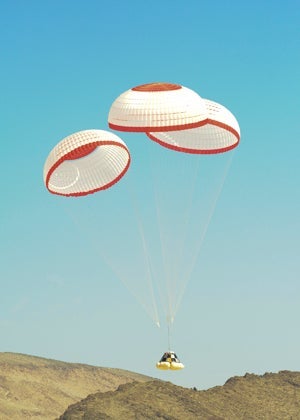
 Boeing’s Crew Space Transportation (CST)-100 spacecraft has successfully conducted its second parachute test, safely demonstrating its complete landing system through a 14,000ft descent on to the Delmar Dry Lake Bed in Nevada, US.
Boeing Commercial Programs vice president and program manager John Mulholland said: "This second parachute drop test validates Boeing’s innovative system architecture and deployment plan."

Discover B2B Marketing That Performs
Combine business intelligence and editorial excellence to reach engaged professionals across 36 leading media platforms.
During the test, a drogue parachute deployment sequence was initiated, followed by the deployment of the main parachute, while the six airbags inflated to cushion the space capsule’s smooth ground landing.
The test was performed with the support of the company’s commercial crew team which includes Bigelow Aerospace, which provided the capsule test article, HDT Airborne Systems, responsible for the design, fabrication and integration of the parachute system and ILC Dover, which designed and fabricated the landing air bag system.
Bigelow Aerospace founder and president Robert Bigelow said: "This successful test provides further proof that the commercial crew initiative represents the most expeditious, safe and affordable means of getting America flying in space again."
To date, Boeing has completed 40 CST-100 milestones, comprising the Preliminary Design Review in February, and has scheduled additional tests to be performed this year.
US Tariffs are shifting - will you react or anticipate?
Don’t let policy changes catch you off guard. Stay proactive with real-time data and expert analysis.
By GlobalDataFurther tests include another landing air bag test series, a forward heat shield jettison test and an orbital manoeuvring/attitude control engine hot fire test to grab more data on spacecraft’s design elements.
The company has selected United Launch Alliance’s Atlas V launch vehicle for the spacecraft’s initial test flights in 2015-16.
Boeing’s CST-100, a reusable spacecraft compatible with various expendable rockets, can transport up to seven astronauts, or a combination of astronauts and cargo.
Image: Boeing’s CST-100 space craft during its second parachute landing test. Photo: courtesy of Boeing.


