
Boeing and Commercial Aircraft of China (COMAC) have opened the new Boeing-COMAC Aviation Energy Conservation and Emissions Reductions Technology Center in Beijing, China, to study biofuels refinement solutions in an effort to reduce carbon emissions.
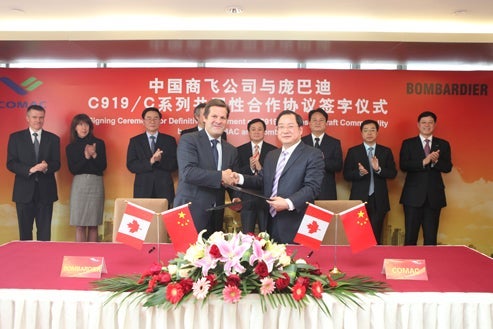
Developed as part of a collaborative agreement signed in March 2012, to support the growth of the commercial aviation industry, the new technology centre’s first research project will focus on refining waste cooking oil (gutter oil), into aviation biofuel.

Discover B2B Marketing That Performs
Combine business intelligence and editorial excellence to reach engaged professionals across 36 leading media platforms.
According to the companies, finding ways for the conversion of discarded gutter oil into jet fuel could improve regional biofuel supplies and enhance the affordability of biofuels.
COMAC vice president, Shi Jianzhong, said energy conservation emission reduction has currently become the focus of the global aviation sector.
"Meanwhile, we wish to construct the new centre as a demonstrative advanced technology center and to make contributions to the development of the aviation industry in China and world with the concerted efforts of both sides," Jianzhong added.
Located in COMAC’s new Beijing Aeronautical Science and Technology Research Institute (BASTRI), the dual funded technology centre has collaborated with Chinese universities and research institutions to enhance knowledge in areas such as sustainable aviation biofuels and air traffic management (ATM).
US Tariffs are shifting - will you react or anticipate?
Don’t let policy changes catch you off guard. Stay proactive with real-time data and expert analysis.
By GlobalDataBASTRI president, Qin Fuguang, said: "With the joint efforts of COMAC and Boeing, Boeing-COMAC Technology Center will make continuous progress and breakthroughs not only in the area of aviation biofuel development, but also other technologies of carbon emission reduction."
Chinese passenger traffic is expected to surpass 300m in 2012 and is expected to reach 1.5bn passengers in 2030, according to a forecast by the Civil Aviation Administration of China.
With surging passenger demand, the country’s airlines have to purchase 5,000 new airplanes by 2030, as reported by Boeing.
Image: COMAC president He Dongfeng and Boeing Commercial Airplanes president and CEO Jim Albaugh during the signing of collaboration agreement during March 2012. Photo: courtesy of Boeing.


