
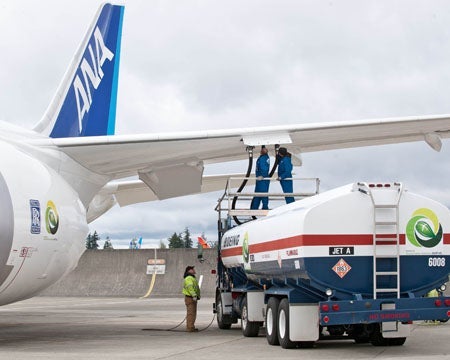
Boeing and All Nippon Airways (ANA) have been successful in conducting the 787 Dreamliner’s first sustainable biofuel flight in a move that demonstrated the aircraft’s environmental performance.

Discover B2B Marketing That Performs
Combine business intelligence and editorial excellence to reach engaged professionals across 36 leading media platforms.
Boeing Commercial Airplanes Environment and Aviation Policy vice president, Billy Glover, said: "The 787 is the most environmentally progressive jetliner flying today, combining fuel efficiency and comfort with reduced carbon emissions."
The ANA delivery flight between Boeing’s Delivery Center in Everett, Washington, US and Tokyo Haneda Airport also marked the first transpacific flight using biofuel.
Commenting on the achievement, ANA senior executive vice president, Osamu Shinobe, said,: "Our historic flight using sustainable biofuels across the Pacific Ocean highlights how innovative technology can be used to support our industry’s goal of carbon-neutral growth beyond 2020."
During the 787 biofuel flight, loaded with a blend of used cooking oil, the aircraft emitted an estimated 30% less CO2 emissions in comparison with similarly-sized modern-day airplanes.

US Tariffs are shifting - will you react or anticipate?
Don’t let policy changes catch you off guard. Stay proactive with real-time data and expert analysis.
By GlobalDataBoeing said that the use of biofuel helps in reducing greenhouse gasses by 10%, while the technology and efficiency advancements offered by the Dreamliner helps in a further reduction of approximately 20%.
ANA, a major player in the design of the Dreamliner, had placed an order with Boeing for 50 Dreamliners in April 2004 and took delivery of its first 787, featuring a short-haul international interior design with business and economy-class cabins, in September 2011.
Powered by General Electric and Rolls-Royce engines, the mid-size, twin aisle, ANA’s Boeing 787 Dreamliner has been built using composite materials instead of aluminium.
The aircraft is capable of carrying 210-250 passengers on long-range routes of about 14,200km to 15,200km.
Image: ANA’s 787 Dreamliner being loaded with sustainable biofuel prior to its first transpacific flight. Photo: Boeing


