
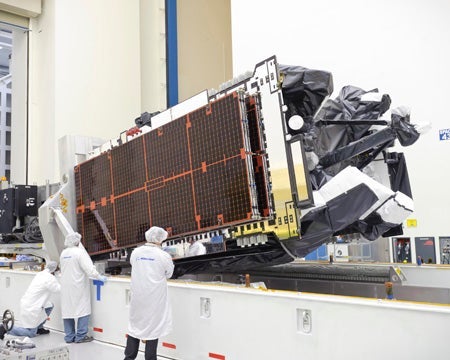
Boeing has delivered the second of four 702MP satellites to Intelsat (IS), paving the way for a late 2012 launch for the company’s newest medium-power satellite.
Scheduled to be launched in the third quarter of 2012, the second 702MP satellite (IS-21) will be injected into orbit aboard a Sea Launch AG Zenit 3SL rocket.

Discover B2B Marketing That Performs
Combine business intelligence and editorial excellence to reach engaged professionals across 36 leading media platforms.
Craig Cooning, Boeing Space & Intelligence Systems vice president and general manager, said: "With the first satellite, Intelsat 22, on orbit and performing as predicted, we are pleased to advance to this next step in Intelsat’s quest to expand its global capacity."
Replacing the current IS-9 satellite at eight degrees west after its launch, the IS-21 will offer high-capacity video service to media clients in Latin America and the Caribbean.
As part of Intelsat’s global Ku-band coverage, scheduled for completion in early 2013, the satellite will also provide South Atlantic coverage for shipping and air traffic clients.
Powered by two solar wings, each with three to four panels of ultra triple-junction gallium arsenide solar cells, the satellite will offer high-capability features as in the Boeing 702HP satellite model, but with a new satellite bus structure and a simple propulsion system.

US Tariffs are shifting - will you react or anticipate?
Don’t let policy changes catch you off guard. Stay proactive with real-time data and expert analysis.
By GlobalDataDesigned to offer 15 years of satellite service, the 702MP platform, can house hosted payload comprising sensors, UHF and Ka-band, for further flexibility in the client’s business planning.
The design of Boeing 702MP also supports payloads with a power range of between six and 12kw and is compatible with the Atlas, Ariane, Proton and Sea Launch launchers.
Image: The second Boeing 702MP satellite being shipped to Intelsat. Photo courtesy of: Boeing.


