
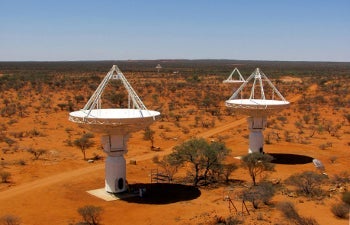
Australia’s Commonwealth Scientific and Industrial Research Organization (CSIRO) has developed the Australian Square Kilometre Array Pathfinder (ASKAP) radio telescope, enabling astronomers to explore the depths of the universe.
Located at Murchison Radio-astronomy Observatory (MRO) in Western Australia, ASKAP features 36 antennas, each measuring 40ft in diameter.

Discover B2B Marketing That Performs
Combine business intelligence and editorial excellence to reach engaged professionals across 36 leading media platforms.
ASKAP telescope is sensitive to even slight radiation from the Milky Way, enabling it to spot distant galaxies.
CSIRO scientist John O’Sullivan was quoted by the BBC as saying that although these telescopes were relatively small, their power enabled a starting point for looking into the origins of galaxies.
Through phased array feed receiver technology developed by CSIRO, ASKAP can examine distant galaxies.
The special wide-angle cameras allow the radio telescope to not only explore 30 times larger area of the sky than the existing technology, but also to scan it much faster.

US Tariffs are shifting - will you react or anticipate?
Don’t let policy changes catch you off guard. Stay proactive with real-time data and expert analysis.
By GlobalDataThese cameras will help astronomers conduct drift-net surveys, and collect data on millions of galaxies, as well as look for blackholes, which are otherwise hard to observe.
Since the telescope is located in a remote area, there would be little disturbance from man-made radio signals.
Research teams from around the world are collaborating with CSIRO in order to maximise the scientific value of large volumes of statistical data.
ASKAP is a part of the A$2bn ($2.03bn) Square Kilometre Array (SKA) project, which will begin construction in 2016.
SKA will feature thousands of radio-wave antennas that will all be linked together by high-bandwidth optical fibre. The project is one of the biggest radio telescope projects in the world.
Image: An elevated view of CSIRO’s new ASKAP antennas at the Murchison Radio-astronomy Observatory (MRO) in Western Australia. Photo: courtesy of Ant Schinckel, CSIRO.


