
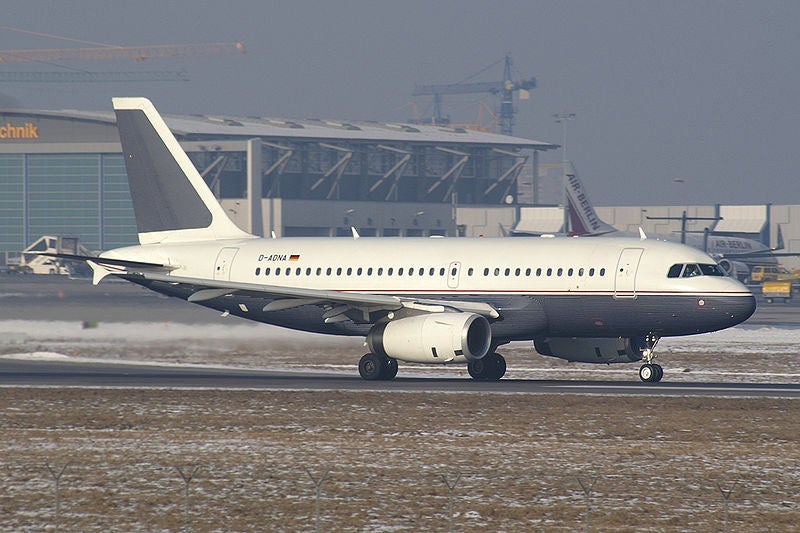
 Airbus’s ACJ318 and ACJ319 corporate jets have received eligibility certification from EASA, FAA and GACA, paving the way for them to participate in federal airworthiness regulation (FAR) part 135 operations.
A variant of its ACJ319 has also cleared CAAC eligibility requirements, which will allow the company to receive approval to carry fare-paying charter passengers.

Discover B2B Marketing That Performs
Combine business intelligence and editorial excellence to reach engaged professionals across 36 leading media platforms.
Part 135 approval is usually sought and received by the operator, while the aircraft involved must satisfy the requirements for eligibility.
The FAR part 135 eligibility is a less demanding approval process than part 121; it is for jets that will be used by operators to transport fewer passengers with reduced frequency and manoeuvres in an environment that is less demanding.
The requirements satisfied by the corporate jets include certification of the cabin for public transport, the number of seats for taxi, take-off and landing to be less than 30, and the payload to range up to 7,500lb.
Part 135 certification also benefits the operator with regards to tax, insurance and simplifies operational procedures depending on the country.
US Tariffs are shifting - will you react or anticipate?
Don’t let policy changes catch you off guard. Stay proactive with real-time data and expert analysis.
By GlobalDataRegulations of either EASA or the FAA are followed by most countries in the world whereas; China draws rules from both authorities.
Around 15 Airbus ACJ318s, ACJ319s and ACJ320 jets are already offered by 15 operators around the world for VVIP charter services.
Featuring wide and tall cabins compared to any other corporate jet, Airbus jets are externally similar in size to traditional large business jets.
More than 170 Airbus corporate jet sales have been recorded to date.
Image: Airbus ACJ319 is operated by operators for VVIP charter services. Photo: courtesy of Juergen Lehle.


