

Terminal 2 (T2) at Kuwait International Airport is being developed by the airport’s operator, the Directorate General of Civil Aviation (DGCA), to transform the airport into a new regional air hub in the Arabian Gulf.
The new T2 is being constructed in three phases. The first phase will add a capacity of 13 million passengers a year, and the subsequent phases will enhance the capacity to 25 million and eventually to 50 million passengers annually.
Recommended White Papers
Recommended Buyers Guides
Construction of T2 started in May 2017 and is expected to be completed in November 2026.
Project background
The State of Kuwait has seen a rapid economic growth due to a significant increase in air traffic at Kuwait International Airport. In 2024, the airport handled 15.4 million passengers, up from 8.5 million in 2011.
The Kuwait Government announced an investment plan for the airport expansion and modernisation to meet future anticipated growth. The project includes the development of a passenger terminal, a third runway, and the expansion and renovation of the two existing runways and other facilities.
Kuwait International Airport T2 features and facilities
The project, which will include approximately 700,000m2 (7.5 million square feet) of gross floor area, is designed to IATA Service Level A.
T2 will have four levels above ground and one underground. It will feature 120 check-in desks and a baggage handling system that will handle 2,930 bags an hour.
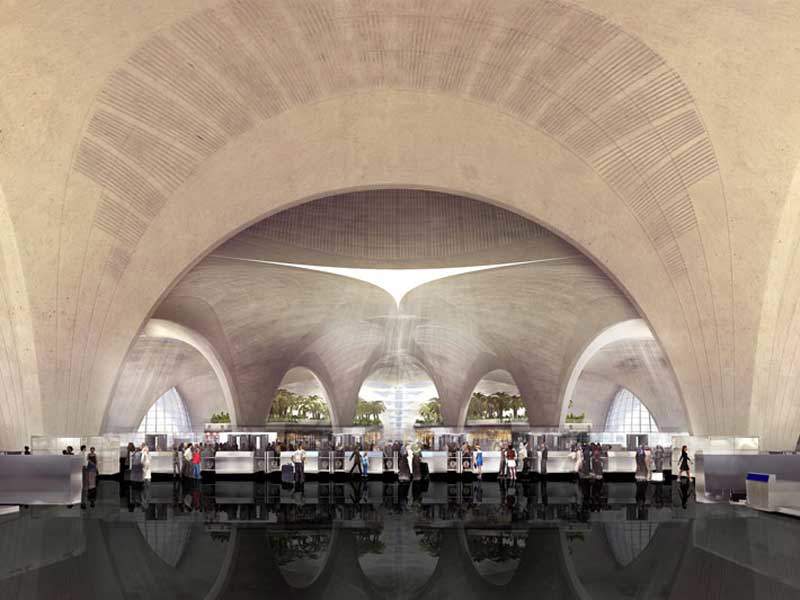
The baggage conveyors will stretch approximately 6km, and there will be high-speed baggage sorters for approximately 1.5km. The integrated baggage system, surrounded by a waterfall, incorporates screening, dynamic storage and sorting capabilities.
In the first phase, T2 will feature between 30 and 51 aircraft contact stands. It will have 36 boarding gates, including 30 contact gates and six remote boarding positions.
Other developments include taxiways, aprons and 28 terminal gates, including eight for Airbus A380 aircraft.
There will be sufficient landside area for parking, ground transportation centres and other landside facilities including offices and the DGCA headquarters and hotels. Measures will be taken to minimise the walking distance from the centre of T2 to the endpoints.
The T2 project further encompasses the construction of a multi-storey car park fitting up to 4,500 cars, a transit hotel, shelters, a central power building, a water storage building, a security building, an infrastructure tunnel and electrical substations.
The terminal will be equipped with Smiths Detection HI-SCAN 10080 XCT units for screening hold baggage and 70 Hi-SCAN 6040 CTiX computed tomography (CT) X-rays.
The passenger terminal, the central station and connections to the service tunnels will be developed in the first phase.
Car parking, service buildings and access roads leading to the new T2 will be developed in the second phase, followed by aircraft parking areas and taxiways in the third phase.
KIA T2 design details
T2’s design is inspired by local art and architecture, while the construction materials will be responsive to the climate, as the airport is located in one of the hottest climate zones on Earth.
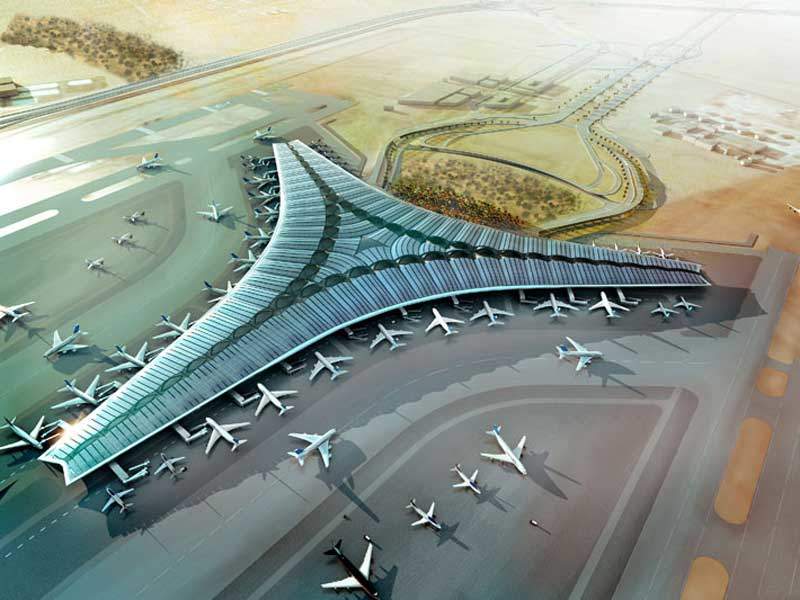
The airport’s architectural plan features a triangular layout. The trefoil plan of T2 features three symmetrical wings of departure gates. The facades will span 1.2km and extend from a 25m-high central space.
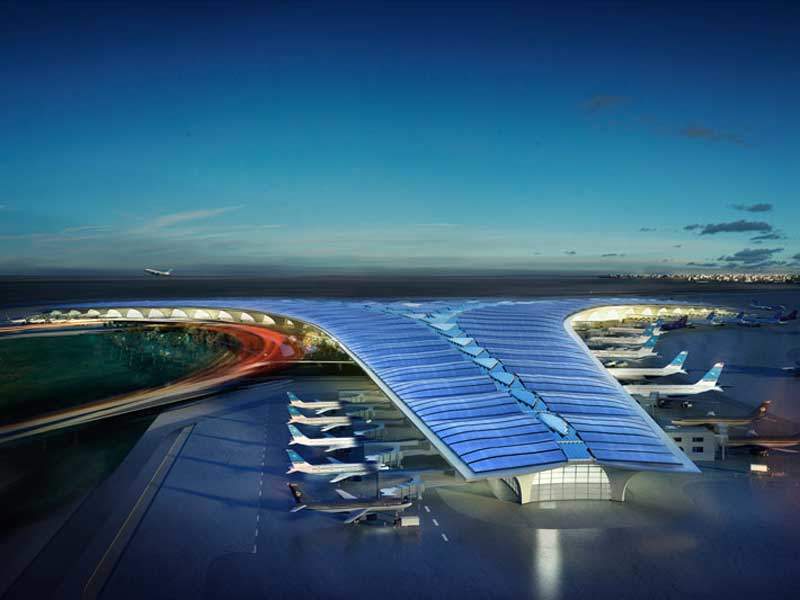
The building will feature a single roof canopy with glazed openings to filter daylight and deflect direct solar radiation.
The canopy, which will be installed with 8,000 skylights, will be extended to the entrance plaza and supported by tapering concrete columns that feature organic forms inspired by the contrast between the solidity of the stone and the movement of Kuwait’s traditional dhow sailing boats.
The interiors of the terminal are designed for simplicity and ease-of-use, with only a few level changes. T2 is being designed with the world’s largest building information modelling (BIM) 3D model. It is also sand, dust and explosion-proof to enhance safety and security and ensure smooth operations.
Access to airport terminal
A new landside access will be created for T2 from the south as a new road connects from the King Faisal Motorway 51 and the 7th Ring Road. Plans are in place to develop a new metro line connecting the airport to Kuwait City centre.
T2 will be accessible via a kerb, a car park, and a bus and coach station. The kerb will feature special lanes and zones for VIP, premium passengers and public vehicles.
The arrivals level in the concourse will feature fixed link bridges leading to the arrivals corridors, before merging into the centre area.
Construction details
The first precast arch, weighing 170 tonnes (t), was installed in April 2018. The total number of precast arches installed is approximately 804–810. The dimensions of the arches vary, ranging between 20m and 39m.
The primary structure comprises 90 precast concrete columns connected by post-tensioning precast arches. The structure gains additional support from 39,800 composite steel and concrete cassettes forming the inner roof.
This project involved more than one million square metres of concrete and over 150,000t of structural steel.
Kuwait International Airport T2 sustainability features
The Kuwait International Airport T2 project is targeting Leadership in Energy and Environmental Design gold certification.
Some of the sustainable features that will be incorporated include thermal-efficient concrete and around 80,000 roof-mounted solar panels for sustainable energy.
Contractors involved
The terminal construction contract was awarded to the Turkish company Limak, while the project management contract was secured by Ineco.
The contract to study, design and supervise the passenger T2 building construction was awarded to Gulf Consult, in association with Foster+Partners (UK).
Arup (UK), NACO and Parsons Brinckerhoff (UK/Kuwait) are the specialist sub-consultants for the project.
Limak appointed Robert Bird Group (RBG) to provide construction engineering services. RBG assisted Limak with the project’s construction methodology and erection sequence.
Werner Sobek was engaged to provide structural engineering of the main structure, BIM services, and facade engineering for the project, while Aecom was contracted to provide architecture, design and BIM management services.
Smiths Detection received a contract to supply hold-baggage screening equipment for T2 in June 2020.
In November 2025, Rolls-Royce won the contract to supply seven mtu backup-power generators for the project.
Other contractors involved in the project include Alternative Energy Projects Company, Power China Guizhou Engineering, Probe Engineering, REXME, Adapa, BEUMER Group, SFMM, DESK Yapi, Mega Yapi, Yapısan, Deerns, Penspen, Mammoet, Evolution Engineering Services and Otis.
Suppliers involved in the project are ASSA ABLOY, TRIMline Interiors and Sociedade Industrial de Britagem.
