
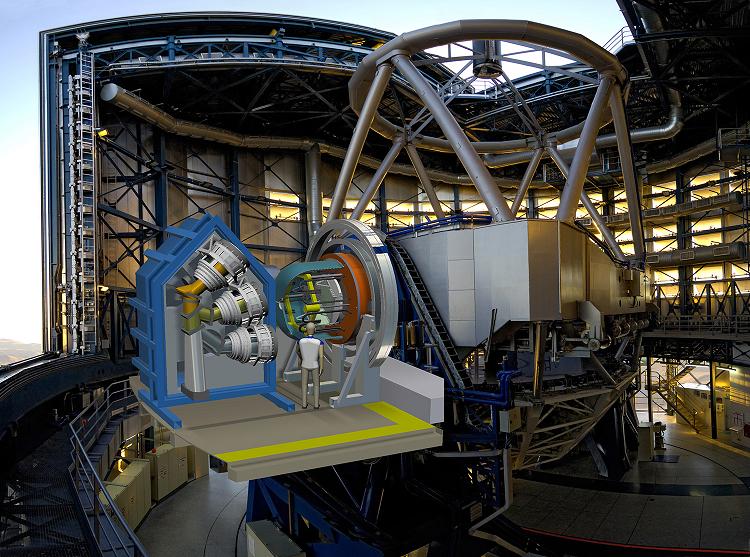
A team led by UK Astronomy Technology Centre (ATC) has won a €9m contract to build multi-object optical and near-infrared spectrograph (MOONS) that will help explore the formation and evolution of stars and galaxies.
The intergalactic GPS instrument is being designed for the European Southern Observatory’s very large telescope in Chile.

Discover B2B Marketing That Performs
Combine business intelligence and editorial excellence to reach engaged professionals across 36 leading media platforms.
Planned to begin operations by 2019, the MOONS will allow astronomers view hidden areas in the Milky Way, located around 40,000 light years away, as well as create a 3D map of galaxy.
It will also allow identifying the early evolution of ultra-distant galaxies.
UK ATC director Gillian Wright said: "The team at UK ATC in Scotland have an opportunity with this project to enable all of us to understand why the Milky Way looks the way it does.
"This instrument will act as an intergalactic GPS to help us to navigate through the billions of stars in our galaxy and create a comprehensive map of its structure."
MOONS will estimate the chemical composition of the objects in the galaxy by analysing the colour of light emitted by them. The instrument is expected to simultaneously observe 1,000 objects using fibre-optic cables.
UK ATC project principal investigator Michele Cirasuolo said: "MOONS is a unique instrument able to pioneer a wide range of galactic, extragalactic and cosmological studies and provide crucial follow-up for major facilities such as Gaia, the Visible and Infrared Survey Telescope for Astronomy (VISTA), Euclid and the Large Synoptic Survey Telescope (LSST)."
The project team will comprise engineers and scientists from Chile, France, Italy, Portugal, Switzerland and the UK.
Operated by the Science and Technology Facilities Council (STFC), the UK ATC will develop the individual motorised systems, cryostat system. The University of Cambridge will develop cameras for the instrument.
Image: An artistic view of the MOONS instrument. Photo: courtesy of STFC.



