
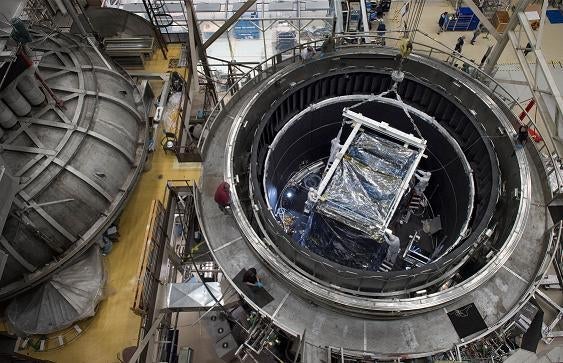
Lockheed Martin and the University of Arizona are preparing to begin the next phase of testing on Near Infrared Camera (NIRCam) instrument on Nasa’s James Webb Space Telescope (JWST).
Said to be the primary science camera on the JWST, the NIRCam plays a role as the sensor to align the observatory’s primary mirror and is designed to see farther into the cosmos and further back in time compared with any other instrument.

Discover B2B Marketing That Performs
Combine business intelligence and editorial excellence to reach engaged professionals across 36 leading media platforms.
The primary mirror on JWST is made of 18 individual segments that will be aligned in space.
Lockheed Martin NIRCam programme manager Alison Nordt said: "We designed NIRCam to stringent optical and environmental requirements so it can deliver images from the early origins of the universe.
"JWST is an infrared observatory, requiring all of the optical components to operate at a cryogenic temperature under 40 Kelvin, which is less than 40° above absolute zero, the temperature at which all atomic motion ceases."
NIRCam has been subjected to various tests during late-2014.

US Tariffs are shifting - will you react or anticipate?
Don’t let policy changes catch you off guard. Stay proactive with real-time data and expert analysis.
By GlobalDataIn early October, NIRCam successfully completed Cryogenic Vacuum Test 2 at Nasa’s at Goddard Space Flight Center, as part of the JWST Integrated Science Instrument Module (ISIM).
These tests were carried out in cryogenic and vacuum conditions to replicate the space environment.
In April, Nasa installed the instrument in the ISIM, which is preparing to undergo vibration testing.
The ISIM will also be subjected to third thermal vacuum test, to evaluate its functions and science instruments before the next level of the telescope integration and testing.
Image: The optical sensor will see farther into the cosmos and further back in time. Photo: courtesy of Nasa / Lockheed Martin Corporation.


