
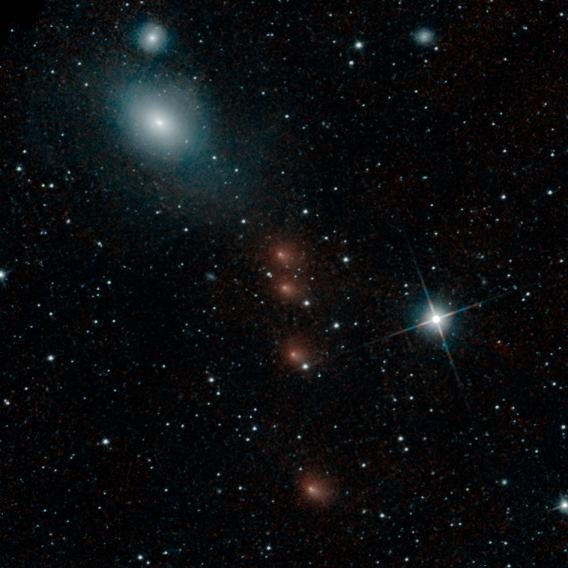
Nasa is preparing to study the Siding Spring comet when it flies past the surrounding areas of Mars on 19 October.
The comet will move at approximately 126,000mph within around 87,000 miles of the Martian area, which represents less than half the distance between earth and moon.

Discover B2B Marketing That Performs
Combine business intelligence and editorial excellence to reach engaged professionals across 36 leading media platforms.
Nasa said that the proximity will enable researchers to accumulate data on the comet and its impact on the Martian atmosphere, through its fleet of assets on and around Mars.
Nasa science mission directorate in Washington astronaut and associate administrator John Grunsfeld said: "This is a cosmic science gift that could potentially keep on giving, and the agency’s diverse science missions will be in full receive mode.
"This particular comet has never before entered the inner solar system, so it will provide a fresh source of clues to our solar system’s earliest days."
The comet originated from the Oort Cloud, a giant group of icy objects believed to be the leftover material from the formation of the solar system 4.6 billion years ago.

US Tariffs are shifting - will you react or anticipate?
Don’t let policy changes catch you off guard. Stay proactive with real-time data and expert analysis.
By GlobalDataNasa expects the images and data gathered by its rovers and satellites, to help researchers understand more about the materials, including water and carbon compounds, that existed during the formation of the solar system.
The agency’s Mars orbiters will accumulate data such as the size, rotation and activity of the comet’s nucleus and gas composition of the coma around it.
Nasa said it has manoeuvred the Mars Odyssey, Mars Reconnaissance Orbiter, and the Mars Atmosphere and Volatile EvolutioN spacecraft, to reduce the impact from high-velocity dust particles coming off the comet.
"The period of greatest risk to orbiting spacecraft will start about 90 minutes after the closest approach of the comet’s nucleus and will last about 20 minutes, when Mars will come closest to the centre of the widening trail of dust flying from the comet’s nucleus," the agency added.
Earth-based and space telescopes, astrophysics space observatories and the ground-based Infrared Telescope Facility will track the celestial object.
Image: Nasa’s NEOWISE mission detected comet C/2013 A1 Siding Spring on 28 July 2014. Photo: courtesy of Nasa / JPL-Caltech.



