

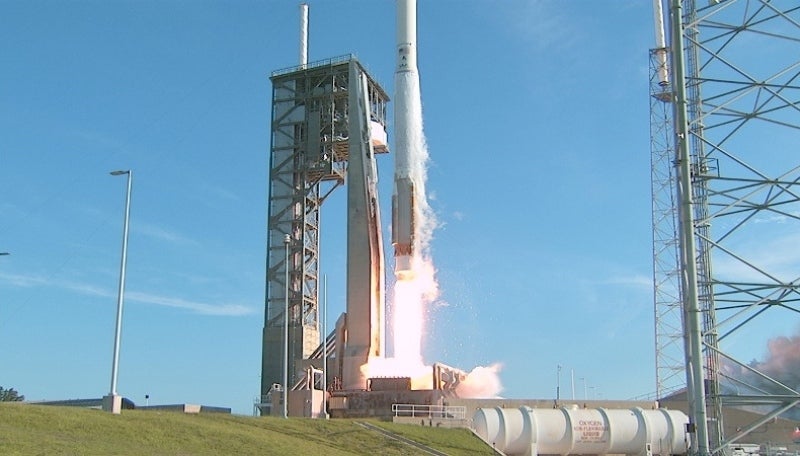
Nasa has launched the third and final probe in a series of its next-generation communications satellite from Cape Canaveral Air Force Station in Florida, US.
Lifted off by a United Launch Alliance (ULA) Atlas V rocket, the newly launched Tracking and Data Relay Satellite-M (TDRS-M) is a part of Nasa’s Space Network, providing navigation and high-data-rate communications to the International Space Station, Nasa’s Hubble Space Telescope, rockets and various other spacecraft.

Discover B2B Marketing That Performs
Combine business intelligence and editorial excellence to reach engaged professionals across 36 leading media platforms.
Set to enter service by early next year, the satellite has already started its four-month check-out in space.
Nasa will conduct additional tests before putting the Boeing-built satellite into service.
The agency’s Launch Services Programme at Florida's Kennedy Space Centre is responsible for managing the launch service of the TDRS-M.
Nasa Maryland Goddard Space Flight Centre TDRS project manager Dave Littmann said: “The TDRS fleet is a critical connection delivering science and human spaceflight data to those who can use it here on Earth.

US Tariffs are shifting - will you react or anticipate?
Don’t let policy changes catch you off guard. Stay proactive with real-time data and expert analysis.
By GlobalData“TDRS-M will expand the capabilities and extend the lifespan of the Space Network, allowing us to continue receiving and transmitting mission data well into the next decade.”
Established in 1973, the TDRS mission seeks to develop, launch and provide data communications relay spacecraft to support Nasa's Space Network.
Functions and operations of the new TDRS-M spacecraft are similar to its predecessors, TDRS-K and TDRS-L, which were respectively launched in 2013 and 2014.
In 1983, Nasa launched the first TDRS satellite.
So far, two of the TDRS satellites have retired from their services, while five of the nine operational satellites have exceeded their design life and continue to provide essential communications and navigation services.
Image: Nasa launches Tracking and Data Relay Satellite-M (TDRS-M) from Cape Canaveral Air Force Station in Florida, US. Photo: courtesy of Nasa.


