
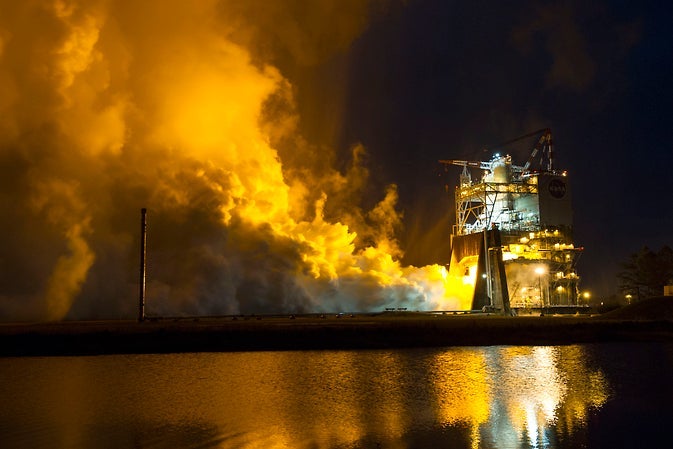
Nasa has completed the first hot fire test of an RS-25 engine of the Space Launch System (SLS), which is designed to provide human exploration beyond low-Earth orbit.
Carried out at Nasa’s Stennis Space Center in Mississippi, the test is the first since the end of space shuttle main engine testing in 2009.

Discover B2B Marketing That Performs
Combine business intelligence and editorial excellence to reach engaged professionals across 36 leading media platforms.
During the test, the RS-25 engine was fired-up for 500 seconds on the A-1 test stand.
Data accumulated from the test will provide engineers with engine controller unit and inlet pressure conditions.
Nasa Marshall Space Flight Center SLS Liquid Engines Office manager Steve Wofford said: "We’ve made modifications to the RS-25 to meet SLS specifications and will analyse and test a variety of conditions during the hot fire series.
"The engines for SLS will encounter colder liquid oxygen temperatures than shuttle; greater inlet pressure due to the taller core stage liquid oxygen tank and higher vehicle acceleration; and more nozzle heating due to the four-engine configuration and their position in-plane with the SLS booster exhaust nozzles."
For future missions, including to an asteroid and Mars, the SLS will be powered by four RS-25 engines.
Scientists have developed an engine controller unit with advanced hardware and software configuration to operate with the SLS avionics architecture.
Following the completion of upgrades on high-pressure industrial water system in April, the agency will resume the engine tests.
The first RS-25 will undergo eight tests totalling 3,500 seconds. The second series of tests include the first test of flight controllers, known as green running.
Initially, the SLS will be configured with a lift capacity of 77t for the first flight test, when it will carry an uncrewed Orion spacecraft beyond low-Earth orbit, to test the performance of the integrated system.
To enable missions even farther into our solar system, the vehicle will be upgraded with a lift capability of 143t.
Image: The RS-25 engine fires up for a 500-second test at Nasa’s Stennis Space Center in Mississippi. Photo: courtesy of Nasa.


