
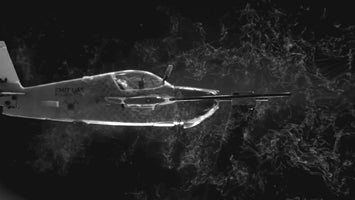
Scientists at RMIT University in Melbourne, Australia, are developing a new system claimed to reduce turbulence on flights.
Built on phase-advanced sensing concept, the turbulence mitigation system for aircraft replicates the way feathers help birds detect disturbances while flying.

Discover B2B Marketing That Performs
Combine business intelligence and editorial excellence to reach engaged professionals across 36 leading media platforms.
RMIT School of Aerospace, Mechanical and Manufacturing Engineering professor Simon Watkins said: "By sensing gusts and disturbances in air flow through their feathers, birds are able to fly gracefully rather than bouncing around in turbulent air.
"The system we have developed replicates this natural technology, with the aim of enabling planes to fly smoothly through even severe turbulence, just like birds."
The phase-advanced sensing concept allows to sense flow disturbance prior to aircraft movement.
In addition to lowering turbulence impact on passengers, the anti-turbulence system is said to reduce loads on aircraft wings, lowering fatigue and extending the life.
US Tariffs are shifting - will you react or anticipate?
Don’t let policy changes catch you off guard. Stay proactive with real-time data and expert analysis.
By GlobalDataWatkins said: "While we need to explore new sensor arrangements to apply this technology to larger and faster aircraft, we have proven the idea on the most challenging problem of keeping small, lightweight planes steady, since these are the ones that get bounced around the most."
Scientists have filed a patent for the project, which is backed by an Australian Postgraduate Award.
The research was carried out by Abdulghani Mohamed under the supervision of Watkins and Reece Clothier.
Image: The anti-turbulence system is said to reduce loads on aircraft wings as well as turbulence impact on passengers. Photo: courtesy of RMIT University.



