
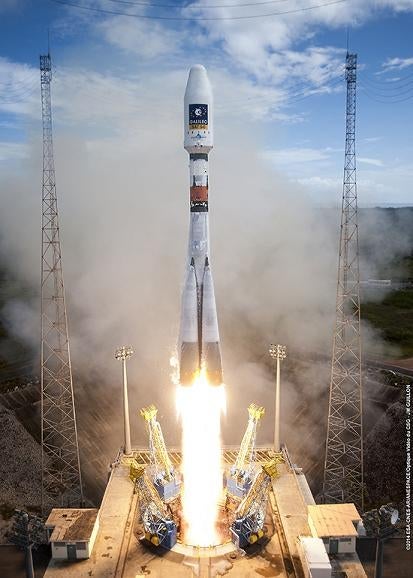
An independent inquiry board has identified that a production glitch in the fourth stage of Soyuz ST-B launcher led to the deployment of Europe’s twin Galileo navigation satellites into wrong orbits earlier this year.
The fourth stage, Fregat, was designed and produced by Russian aerospace firm NPO Lavochkin.

Discover B2B Marketing That Performs
Combine business intelligence and editorial excellence to reach engaged professionals across 36 leading media platforms.
The Galileo 5 and 6 satellites were lofted from the spaceport in Kourou, French Guiana, on 22 August.
The European Space Agency (ESA), European Commission and Arianespace have established the inquiry commission later that month.
The board confirmed that the three-stage Soyuz launcher mission proceeded as expected.
Arianespace said: "The inquiry board also eliminated the hypothesis that the anomaly could have been caused by the abnormal behaviour of the Galileo satellites."

US Tariffs are shifting - will you react or anticipate?
Don’t let policy changes catch you off guard. Stay proactive with real-time data and expert analysis.
By GlobalDataThe problem occurred in Fregat at the beginning of the ballistic phase prior to the second ignition of this stage, the board confirmed.
The loss of inertial reference for the stage caused an error in the thrust orientation of the main engine resulting in orbital error.
This occurred as the Fregat’s inertial system operated outside its authorised operating envelope due to failure of attitude control thrusters.
"The root cause of the anomaly on flight VS09 is therefore a shortcoming in the system thermal analysis performed during stage design, and not an operator error during stage assembly," added the statement from Arianespace.
The board has recommended certain actions, including modifications to the system thermal analysis, associated corrections in the design documents, and modification of the manufacture, assembly, integration and inspection procedure documents.
With these measures in place, the Soyuz launcher is expected to resume launches from December.
Image: The Galileo 5 and 6 satellites were lofted on 22 August aboard a Soyuz ST-B launcher. Photo: courtesy of 2014 ESA-CNES-Arianespace / Photo Optique Vidéo.



