

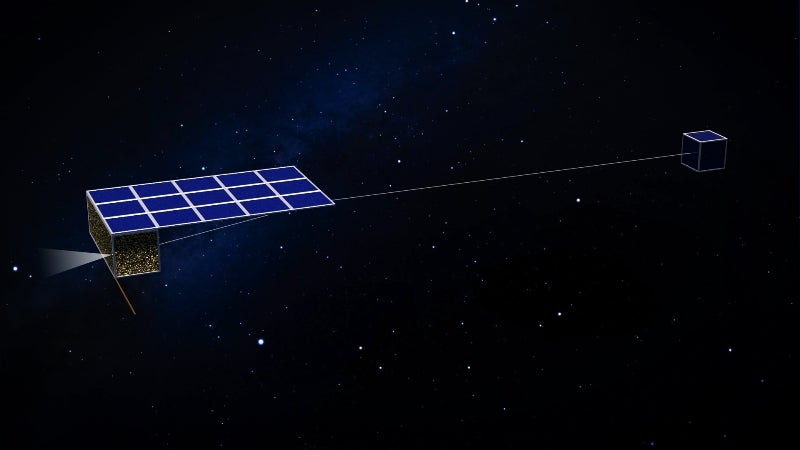
Scientists at the Finnish Meteorological Institute have proposed the development of a fleet of 50 miniature satellites that will study the behaviour of more than 300 asteroids over a period of three years.
The proposal has been made as part of a mission study led by Finnish Meteorological Institute (FMI).

Discover B2B Marketing That Performs
Combine business intelligence and editorial excellence to reach engaged professionals across 36 leading media platforms.
The Asteroid Touring Nanosat Fleet features 50 spacecraft propelled by innovative electric solar wind sails (E-sails), which will produce propulsion and eliminate the use of propellant.
The fleet is also equipped with instruments to capture images and collect spectroscopic data on the composition of the asteroids.
Each satellite is expected to visit six or seven asteroids before returning to Earth to deliver the data.
A sum of around €60m is estimated to be required for the proposed mission, while the research has been led by Dr Pekka Janhunen from FMI who has presented the concept at this year’s European Planetary Science Congress (EPSC).
US Tariffs are shifting - will you react or anticipate?
Don’t let policy changes catch you off guard. Stay proactive with real-time data and expert analysis.
By GlobalDataJanhunen said: “Asteroids are very diverse and, to date, we’ve only seen a small number at close range.
"To understand them better, we need to study a large number in situ. The only way to do this affordably is by using small spacecraft.
“The nanosats could gather a great deal of information about the asteroids they encounter during their tour, including the overall size and shape, whether there are craters on the surface or dust, whether there are any moons, and whether the asteroids are primitive bodies or a rubble pile.
“They would also gather data on the chemical composition of surface features, such as whether the spectral signature of water is present.”
During their mission, the nanosats will be able to fly by their target asteroids at a range of around 1,000km.
Each of the probes will feature a 4cm telescope capable of imaging the surface of asteroids with a resolution of 100m or more.
Image: Artist’s concept of the spacecraft. Photo: courtesy of FMI.


