
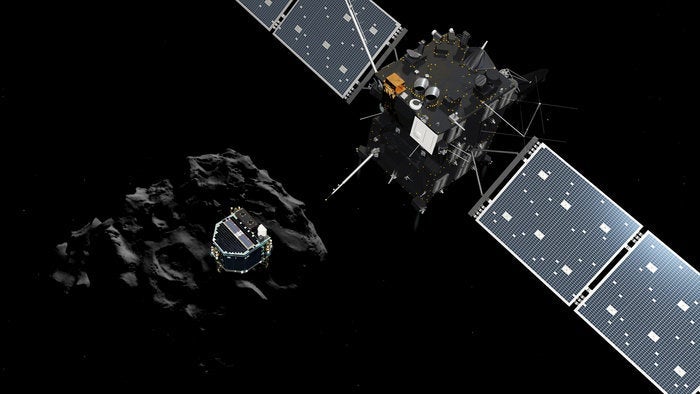
The European Space Agency’s (ESA) Rosetta spacecraft has successfully placed a small lander, Philae, onto the surface of the 67P/Churyumov-Gerasimenko comet.
It is the first time in the history of space exploration that a robot has landed on a comet after more than a ten-year, six billion kilometre journey through space.

Discover B2B Marketing That Performs
Combine business intelligence and editorial excellence to reach engaged professionals across 36 leading media platforms.
ESA director-general Jean-Jacques Dordain said: "Our ambitious Rosetta mission has secured another place in the history books: not only is it the first to rendezvous with and orbit a comet, but it is now also the first to deliver a probe to a comet’s surface."
The 100kg lander arrived at the comet on schedule. A thruster, which was intended to push the robot, and harpoons which were used to anchor it to the surface failed to deploy as planned, causing the Philae to bounce away from the landing site.
DLR German Aerospace Center Philae lander manager Stefan Ulamec told reporters: "Maybe today we didn’t just land once but twice."
ESA Rosetta spacecraft operations manager Sylvain Lodiot said: "One of the greatest uncertainties associated with the delivery of the lander was the position of Rosetta at the time of deployment, which was influenced by the activity of the comet at that specific moment, and which in turn could also have affected the lander’s descent trajectory."
US Tariffs are shifting - will you react or anticipate?
Don’t let policy changes catch you off guard. Stay proactive with real-time data and expert analysis.
By GlobalDataThe landing site called Agilkia is located on the head of the double-lobed object, and was selected based on images and data collected at distances of 100km from the comet.
If the Philae works as planned, it will carry out various scientific experiments on the comet and analyse the surface chemical composition.
Data accumulated from the experiments will assist scientists to gain insights into the solar system’s 4.6 billion year history.
The €1.4bn Rosetta mission is designed to study the Jupiter-family comet and its environment
The spacecraft, launched on-board an Ariane rocket in March 2004, reached the 67P comet in August.
Image: Artistic view of Philae separating from Rosetta and descending to the surface of the 67P/Churyumov-Gerasimenko comet. Photo: courtesy of ESA/ATG medialab.



