
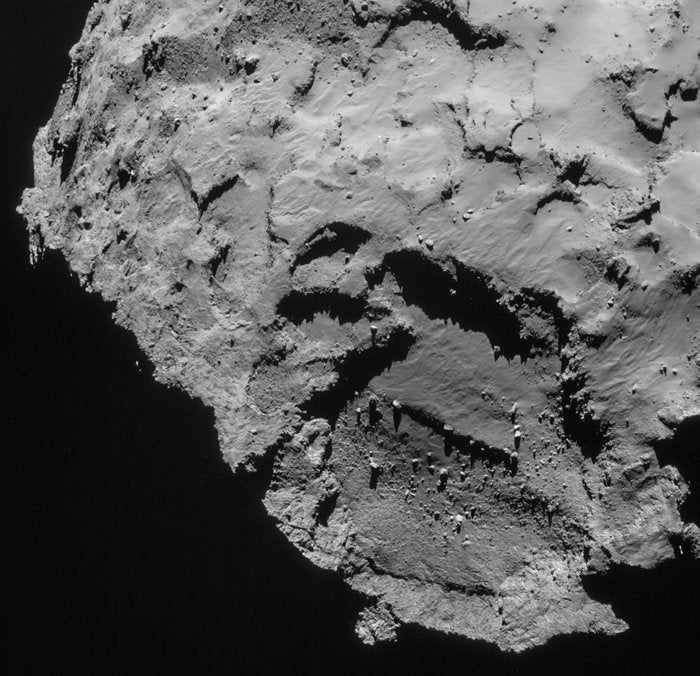
The European Space Agency’s (ESA) Rosetta spacecraft is preparing to launch a small lander, Philae, onto the surface of the 67P/Churyumov-Gerasimenko comet on 12 November.
Launched on-board an Ariane rocket in March 2004, the Rosetta spacecraft is designed to study the Jupiter-family comet and its environment.

Discover B2B Marketing That Performs
Combine business intelligence and editorial excellence to reach engaged professionals across 36 leading media platforms.
The comet is understood to be a remnant of the solar system’s estimated 4.6 billion-year history.
The spacecraft made its rendezvous with 67P in August after a ten-year, six billion kilometre journey.
Designated as Site J, the landing site of Philae is on the head of the comet and is located on the smaller of the comet’s two ‘lobes’. The backup, Site C, is located on the body of the comet.
Targeting Site J, Rosetta will release Philae at a distance of 22.5km from the centre of the comet with landing expected around seven hours later.

US Tariffs are shifting - will you react or anticipate?
Don’t let policy changes catch you off guard. Stay proactive with real-time data and expert analysis.
By GlobalDataIf the backup Site C is selected, separation will occur 12.5km from the centre of the comet and landing is expected to take place around four hours later.
The ESA said: "Site J was chosen unanimously over four other candidate sites as the primary landing site because the majority of terrain within a square kilometre area has slopes of less than 30° relative to the local vertical and because there are relatively few large boulders.
"The area also receives sufficient daily illumination to recharge Philae and continue surface science operations beyond the initial 64-hour battery-powered phase."
The agency said that a final confirmation on the primary landing site will be announced on 14 October following a lander operations readiness review.
The review will include the results of analysis of the landing sites performed until then.
Using its 11 science instruments, the Rosetta orbiter will continue to study the comet.
The comet is located on an elliptical 6.5-year orbit that takes it from beyond Jupiter at its furthest point to between the Mars and Earth orbits at its closest to the Sun.
Image: Landing site J in Rosetta’s NavCam. Photo: courtesy of ESA / Rosetta / NAVCAM.



