
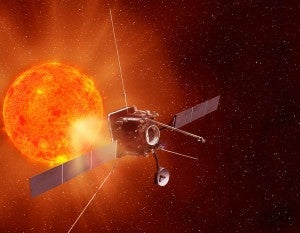
Airbus Defence and Space has completed the structural and thermal model (STM) of the European Space Agency’s (ESA) Solar Orbiter, and is preparing to ship the STM to IABG in Germany for mechanical testing.
The three-month mechanical testing is said to be a key step in verification phase of the project.

Discover B2B Marketing That Performs
Combine business intelligence and editorial excellence to reach engaged professionals across 36 leading media platforms.
After the tests, Airbus Defence and Space will integrate the STM’s stood-off radiator assemblies (SORA) at its facility in Stevenage, and will again ship it IABG for thermal testing.
Planned for launch in 2018, the Solar Orbiter mission is designed to study how the Sun creates and controls the heliosphere.
Heliosphere is the extended atmosphere of the Sun that extends far beyond our solar system.
The spacecraft will fly for approximately three years to within 45 million kilometres of the Sun where the sunlight is thirteen times more intense than it is for satellites orbiting the Earth.

US Tariffs are shifting - will you react or anticipate?
Don’t let policy changes catch you off guard. Stay proactive with real-time data and expert analysis.
By GlobalDataTo withstand such intense thermal radiation, the spacecraft will feature a heatshield and solar array technology.
A suite of instruments on the spacecraft will evaluate the particles, fields and plasma waves through which it travels, while studying the Sun’s surface and outer atmosphere, the photosphere and corona.
Accumulated data will assist scientists in understanding the mechanisms on the Sun that cause disruptions to satellites and Earth based systems.
Solar Orbiter, which is collaboration between the ESA and Nasa, comes after successful missions such as SoHO and Ulysses. It has become the first mission in ESA’s Cosmic Vision programme to start its implementation phase.
Image: The Solar Orbiter mission is designed to study how the Sun creates and controls the heliosphere. Photo: courtesy of Airbus Defence and Space.


