
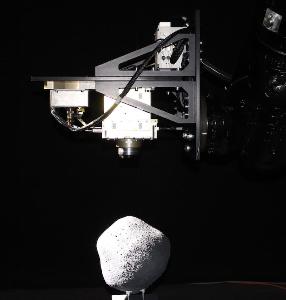
The European Space Agency (ESA) has used a robotic arm to simulate the final approach of an asteroid.
The final approach is being practiced as it prepares for its proposed Asteroid Impact Mission (AIM), the agency’s first mission to a double asteroid.

Discover B2B Marketing That Performs
Combine business intelligence and editorial excellence to reach engaged professionals across 36 leading media platforms.
During the trial, conducted at Spanish company GMV’s Madrid headquarters, the agency placed a real spacecraft camera on a robotic arm and manoeuvred the arm with a dedicated navigation software to zoom in on an asteroid model.
ESA guidance specialist Massimo Casasco said: "By including an actual navigation camera in the loop, we made the test as realistic as possible."
ESA will use standard startrackers and radio ranging equipments in its deep space AIM mission, scheduled to be launched in 2020.
In order to have a successful approach to Didymos double asteroids, AIM will use Mascot-2 lander to move towards the smaller of the two asteroids for comprehensive observations, as well as placing a lander.
Mascot-2 lander is now undergoing tests by its designer DLR space agency in Germany.
The lander will make soft landing on the surface of the asteroids. It has been designed on the similar lander used by Japan’s Hayabusa-2. The lander is scheduled to reach asteroid Ryugu in 2018.
The AIM is a low-budget mission, which will use smart visual navigation software to keep track of its movements over the surface of an asteroid instead of using expensive dedicated proximity sensors.
For measuring height above the surface and reduce operational costs, the mission might reuse its laser communication package.
ESA AIM project manager Ian Carnelli said: "One of AIM’s objectives is to put down a lander on the smaller of the Didymos asteroids using onboard autonomy and very limited resources.
"The ultimate goal for AIM is to demonstrate new ways to explore small solar system bodies in the future.
"So we are testing this approach as fully as possible. In effect, the test bench is a fully fledged optical and robotic laboratory, testing AIM’s approach and the lander descent right down to deployment altitude."
AIM’s first major design review will be held next month, followed by a detailed designing of the mission in February.
NASA is also planning a double asteroid redirection test (DART) to probe same asteroid, but AIM will provide a detailed before-and-after mapping, which aims to help assessing the effects and test planetary defence techniques.
Image: Camera by model asteroid. Photo: courtesy of ESA.


